









Is it possible to regain your old padel ranking after several years without playing? The question comes up regularly among athletes, especially when they want to return to competition after a long break. On Instagram, a reader of Padel Magazine We were recently asked: "Are we still ranked in padel by the FFT if we haven't renewed our license for more than two years?" The answer requires some explanation. Between the rolling twelve-month ranking , the assimilations based on previous results and the specific arrangements in the event of injury or maternity Several situations are possible.
Two years without a license: does one automatically lose their ranking?
First, we need to distinguish between two elements: the FFT license et the sports ranking .
The license allows participation in sanctioned competitions. It must be renewed to register for new tournaments.
The padel ranking system works differently. It is based on sporting results recorded by the French Tennis Federation.
According to the FFT regulations applicable to the 2026-2027 season, the ranking is calculated each month based on the twelve best results obtained during the last twelve months .
Therefore, a player who does not play any tournaments for two years normally no longer retains any points from their previous results in the rolling calculation.
But that doesn't necessarily mean he'll have to start over like a beginner.
The FFT is indeed planning a mechanism to take into account certain previous rankings.
The assimilation system: regaining a ranking based on past results
This is probably the most important point for players who want to resume playing after a long break.
The FFT has put in place a classification assimilation system intended particularly for former players of a good level.
This system allows for the assignment of a ranking that corresponds approximately to the player's sporting level, even if their previous points are no longer included in the calculation for the last twelve months.
According to the 2027 Padel Competition Guide, players who have reached, since October 2018:
- The French Top 15,000 Men ;
- The French Top 1,000 Women .
Assimilation then depends on the best ranking obtained and seniority.
Therefore, it does not guarantee that it will regain exactly its former ranking.
Example: Can a former Top 500 player regain a ranking after several years?
Yes. The FFT grid provides for several levels of reclassification based on past performances.
Let's take the example of a player who had reached the French Top 500 before stopping competition.
His assimilation will depend on the period in which he achieved his best ranking.
| Former best men's ranking | Obtained 0 to 2 years ago | 3 to 5 years ago | 6 to 10 years ago |
|---|---|---|---|
| Top 20 | 100 | 300 | 600 |
| 21 to 50 | 300 | 600 | 1 500 |
| 101 to 300 | 750 | 2 500 | 3 500 |
| 301 to 500 | 1 500 | 3 500 | 5 000 |
| 501 to 1 | 3 000 | 5 000 | 7 500 |
| 1 to 001 | 6 000 | 10 000 | 15 000 |
Source: FFT Padel Competition Guide 2027, Chapter II, table of equivalencies based on the old padel ranking, page 12 of the guide.
These figures correspond to rankings assigned by assimilation , and not at points.
A player formerly ranked 400th in France could thus benefit from assimilation to the 1,500th rank if his best ranking falls within the most recent period provided for by the scale.
This mechanism helps to prevent a former player of a very good level from returning to competition with a ranking that does not correspond to his abilities.
And what about the female players?
The FFT also plans a specific grid for women.
The principle remains the same: The best ranking obtained and the seniority of the individual determine assimilation. .
| Former best women's ranking | 0 to 2 year-olds | 3 to 5 year-olds | 6 to 10 year-olds |
|---|---|---|---|
| Top 20 | 50 | 80 | 120 |
| 21 to 50 | 80 | 150 | 300 |
| 101 to 200 | 300 | 600 | 1 000 |
| 301 to 500 | 1 000 | 1 500 | 2 500 |
| 501 to 1 | 1 500 | 3 000 | 5 000 |
Source: FFT Padel Competition Guide 2027, Chapter II, Assimilation Grid, page 12.
Players who have already reached the Top 1000 can therefore, under the conditions of the regulations, regain a ranking by assimilation after an interruption.
A former tennis player can also obtain an equivalent qualification in padel.
Another situation that is sometimes overlooked: Tennis rankings can allow for assimilation to padel .
The FFT is planning a system for players who have been ranked at least 15 in tennis .
The assigned ranking depends on the highest level achieved and the length of time spent at the club.
For example, a player who has been ranked between 15 and 3/6 in tennis over the last five years may be eligible for assimilation to 7,500th male ranking .
For a player who has achieved an equivalent ranking over the same period, the planned assimilation is 1,500th French woman .
The FFT specifies, however, that a player who has already benefited from this tennis assimilation, then played twelve padel tournaments over twelve months and obtained a padel ranking, will no longer be able to benefit again from this assimilation based on his former tennis level.
Injury or illness: can you keep your ranking during your absence?
The situation is different when a player has to interrupt the competition for a medical reason.
The FFT regulations stipulate a ranking blocked due to health reasons , under certain conditions.
For the 2026-2027 season, this system applies to:
- Players ranked in the French Top 2,000 ;
- The players ranked in the French Top 500 .
To benefit from it, you must, in particular, provide proof of a a break from competition for at least five consecutive months .
The application must be accompanied by a medical certificate and addressed to the padel department of the FFT.
This is a so-called "semi-locked" ranking: during the protection period, the player cannot fall below the protected rank, but their ranking can improve thanks to new results.
How long does protection last after an injury?
The system is subject to several deadlines.
The resumption must take place after the minimum five-month shutdown and within the regulatory window provided, which can last up to approximately 24 months depending on the date of the first calculation of the blocked classification.
Once competition resumes, the protection applies until tenth tournament or for a maximum period of six calendar months , according to the release procedures stipulated by the FFT.
An injured player cannot therefore automatically request to retain their ranking indefinitely.
He must meet the sporting and medical requirements, then comply with the federal procedure.
Maternity: players can also benefit from a protected ranking
The FFT includes a specific provision for players who interrupt their competitive practice due to a maternity .
Unlike the general medical device, this measure is not limited to Top 500 players.
The licensed players had to interrupt competitions during at least five consecutive months they can request a freeze on their ranking.
The request must be made in particular before any resumption of matches after the period of interruption in question.
The regulations also provide for a resumption within the permitted timeframe, with protection of the ranking during the first tournaments following the return.
The reference ranking corresponds to the last ranking published after the last tournament played before the interruption.
This measure aims to prevent a player from being penalized in sporting terms by an absence related to her maternity.
How do I request a ranking freeze?
For maternity or medical reasons, the request must be addressed to the FFT padel management .
The regulation specifically provides for the transmission of:
- A request specifying the situation of the player;
- A medical certificate justifying the interruption of the competition;
- From the start date of the sports break.
Applications should be sent to the following address: padel@fft.fr .
It is best to take the necessary steps before the resumption of competition, as an early return may result in the end of protection.
Is it mandatory to be affiliated with a club to resume competition?
No. We must distinguish a club's affiliation with the FFT , a player's sporting affiliation with a club and possession of a license.
A player wishing to resume competition can obtain a FFT Club license with a club or subscribe to a license outside the club directly online.
For the 2026-2027 sports season, the adult rates announced by the FFT are:
- 33 Euros for an FFT Club license;
- 51 Euros for a non-club license.
These licenses allow participation in sanctioned competitions, subject to other regulatory conditions.
However, Discovery license does not allow direct participation in sanctioned tournaments.
Since 2026, the FFT has also offered a system of membership in a padel club , which may be different from the club's license.
This connection is particularly relevant to the conditions of participation in team championships and territorial competitions.
It should not be confused with classification assimilation, which is based on sporting criteria.
What practical steps should you take when you resume playing padel after two years?
A player wishing to return to competition after a long break can follow several steps.
- View your Ten'Up profile to check his current ranking and sports information.
- Renewing your FFT license , in a club or outside of a club.
- Check your previous best ranking , especially if he has already reached the Top 15,000 for men or the Top 1,000 for women.
- To monitor its potential assimilation at the time of registration for a tournament.
- Contact the FFT in the event of an anomaly, a special situation or a request requiring federal intervention.
For players eligible for automatic assimilation based on their previous padel or tennis ranking, no special steps are normally required when the federal system recognizes their history.
However, some situations require a specific request to the padel management.
Can we resume with a different ranking than the one we had before?
Yes, and it's even common after a long break.
The FFT ranking corresponds to an updated sporting hierarchy, which evolves with the results and the number of competitors.
A former player ranked 1000th will therefore not automatically regain that position after several years without tournaments.
He may be able to benefit from an assimilation corresponding to his best past ranking, according to the applicable scales.
In some cases, the assigned ranking will be significantly lower than the one he held before his stoppage.
Conversely, a player who does not meet the assimilation criteria will have to rebuild their ranking based on their new results.
The system thus seeks to find a balance between taking into account the historical level of the players and the evolution of the sporting hierarchy.

Franck Binisti discovered padel at the Club des Pyramides in 2009 in the Paris region. Since then, padel has been part of his life. You often see him touring France to cover major French padel events.






































































 FIP rankings – Guichard drops, Fonteny moves closer to the top 100, Robert makes a great move
 Lebrón / Augsburger: Brussels had sent a message, Dubai reinforces the threat
 Dubai P1 – Fernández / Calvo: “Any of the three best pairs could be world number 1”
 4PADEL is recruiting a padel coach in Reunion Island: permanent contract or freelance
 Two and a half years to create a padel racket: HEAD reveals the manufacturing secrets of its 2027 models
 Javier Rodríguez Piris: “I would like Spain to host the World Championships in 2030”
 "We're not a tournament club": the gamble taken by the two Henry sisters who are hosting a P3000 at The Break Padel Club
 “Victim of Padel ": The Adventure Padel Jack Troster and Jack Troster are back with a new track and a crazy music video.
 Bullpadel 2027 in the feminine: the queens take to the track
 Blanqué and Joris remain untouchable, securing the title at the P3000 Break Padel Club
 Three consecutive serves in the Dubai final: the recurring umpiring error Premier Padel
 Padel, weight training, and even HYROX: clubs are changing their model
 Padel court rentals: a global market estimated at 4,6 billion euros
 FIP Beyond: the new global padel circuit for amateurs and seniors
 More than 6,300 FIP-ranked players: professional padel is becoming international, but Spain dominates
 OSS Barcelona – Why Spain and France aren't yet playing in the same league
 Cancer and rehabilitation: could padel become a therapeutic tool?
 Padel injuries: ankle, knee, elbow, eye… what the latest figures reveal
 Shocking turn of events at Dubai P1: Coello and Tapia have also withdrawn!
 Padel serve: a good serve is especially good preparation for the third shot.
 What the analysis of the stroke reveals: tennis forehand vs. padel bandeja
 Has the bandeja disappeared from modern padel?
 Flat forehand in padel: 5 exercises from Cristian Álvarez to gain control and efficiency
 Why can Libaak/Alfonso beat almost everyone… except Coello/Tapia?
 Tapia reveals his recipe for beating Coello / Tapia: "I would bet everything on myself"
 How Coello defused Chingotto's game plan
 In padel, does the chemistry between a pair count as much as individual skill?
 Organising a national padel competition: what are the FFT's requirements for clubs?
 Organising a P2000 or a P3000: how much does it really cost clubs?
 P2000 or P3000: what are the differences in prize money, format and organization in 2028?
 Memory, reflexes, concentration: what happens in our brain when we play padel?
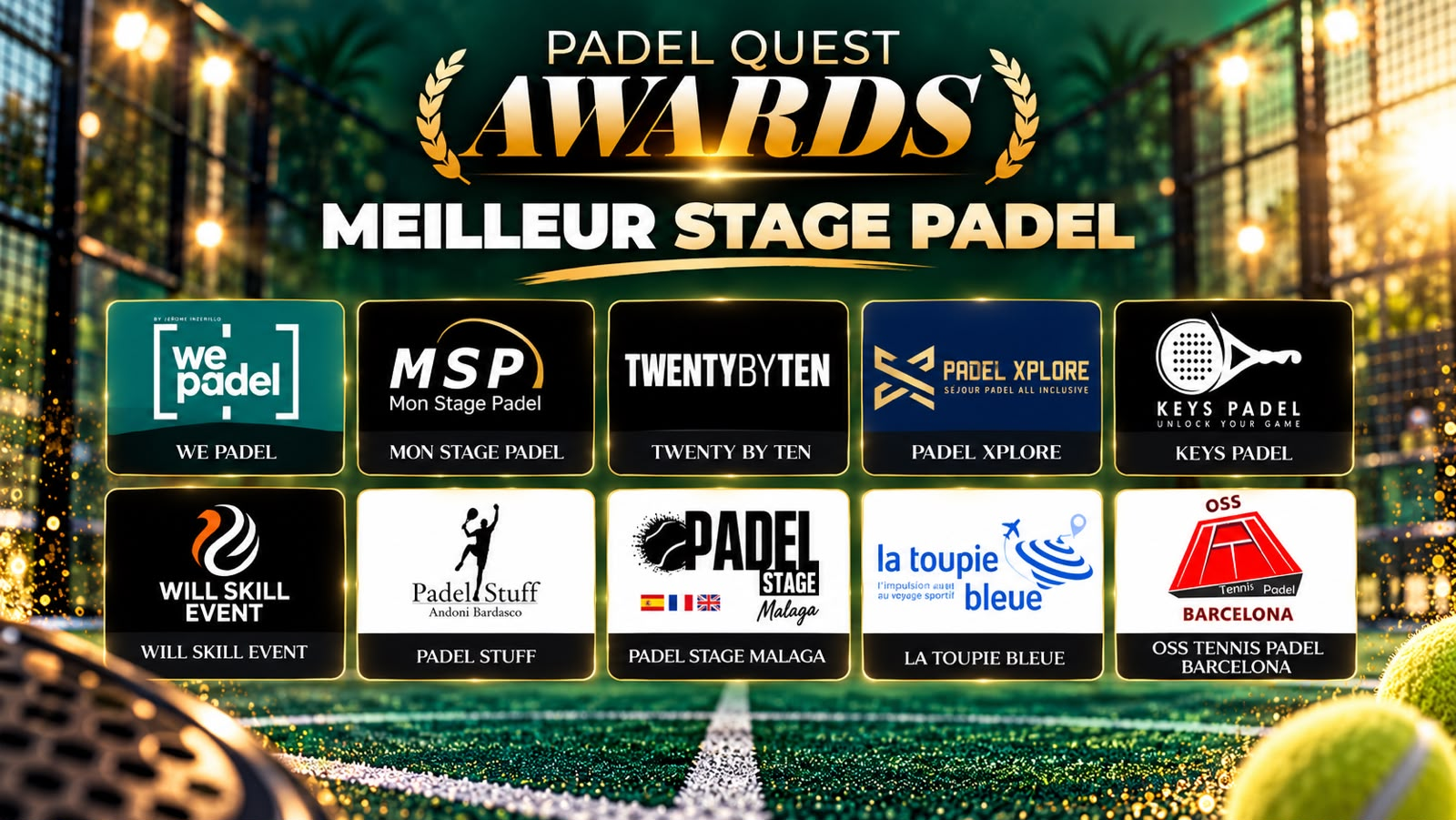 Padel Quest Awards: Ten specialists in the running for the title of best padel training camp of the year
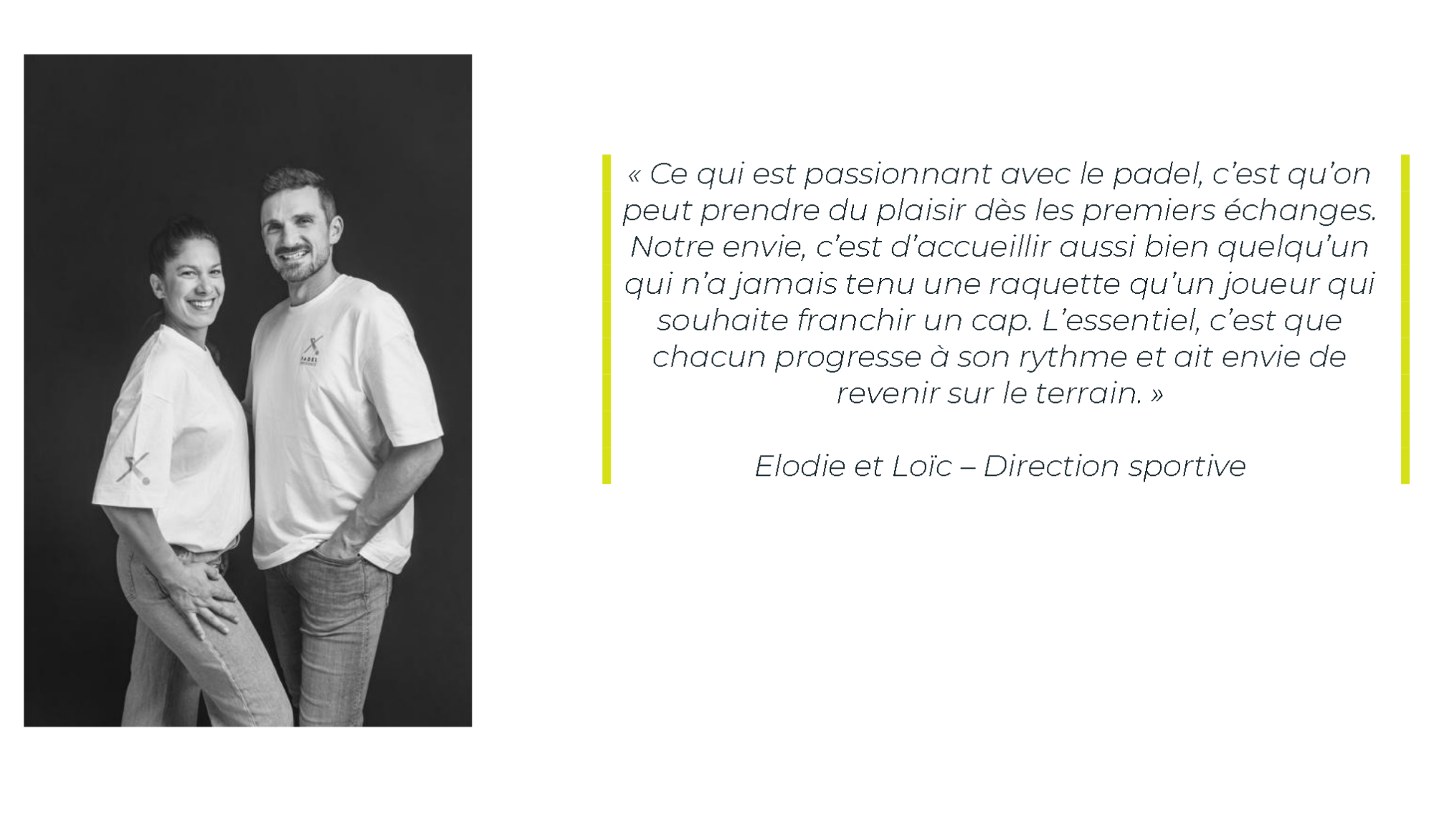 Padel Xperience: The Academy opens on November 2nd in Marcheprime, ahead of the complex's inauguration in 2027
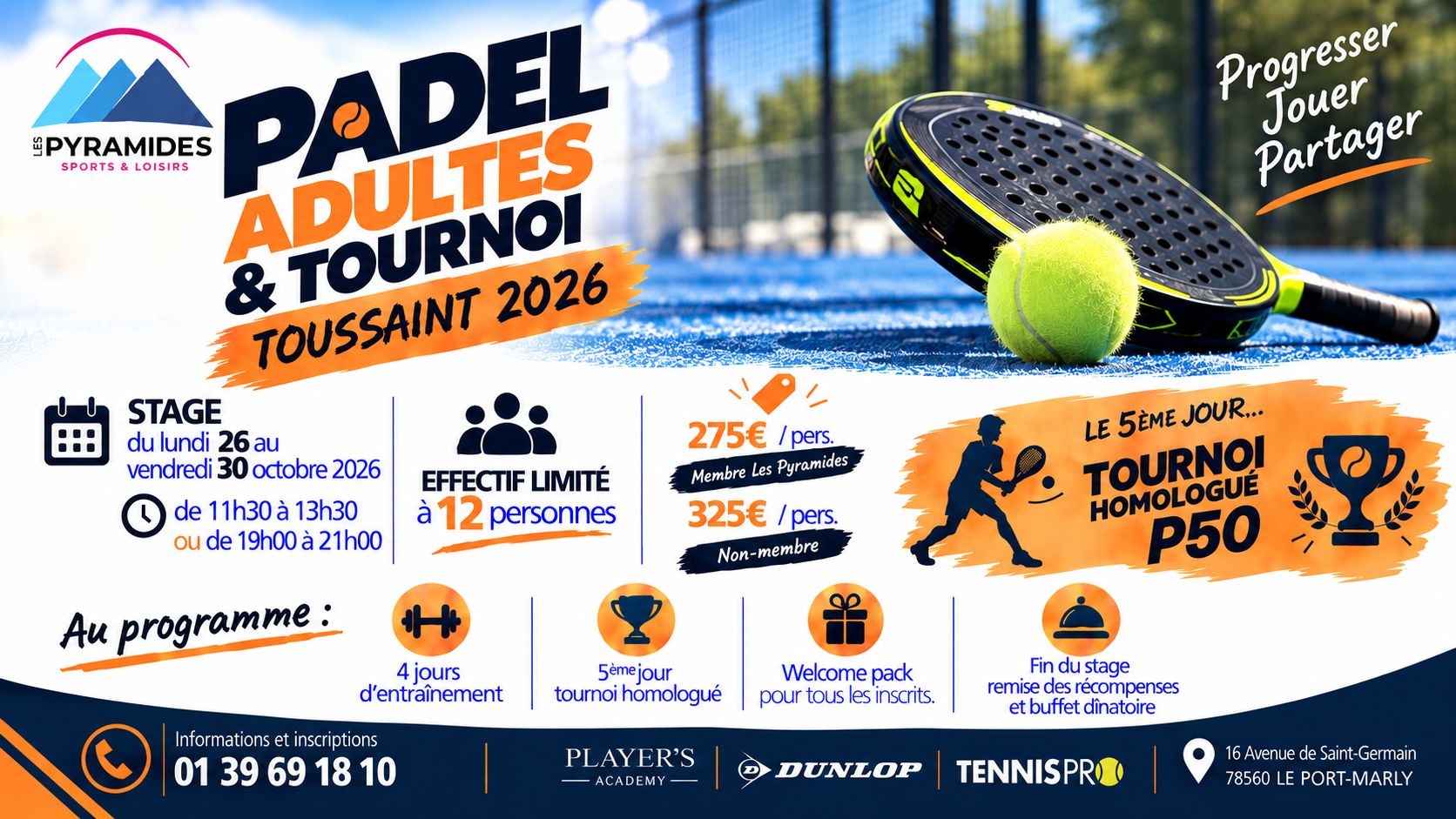 All Saints' Day – Les Pyramides are organizing a padel training camp for adults with a P50 tournament to close out the week