

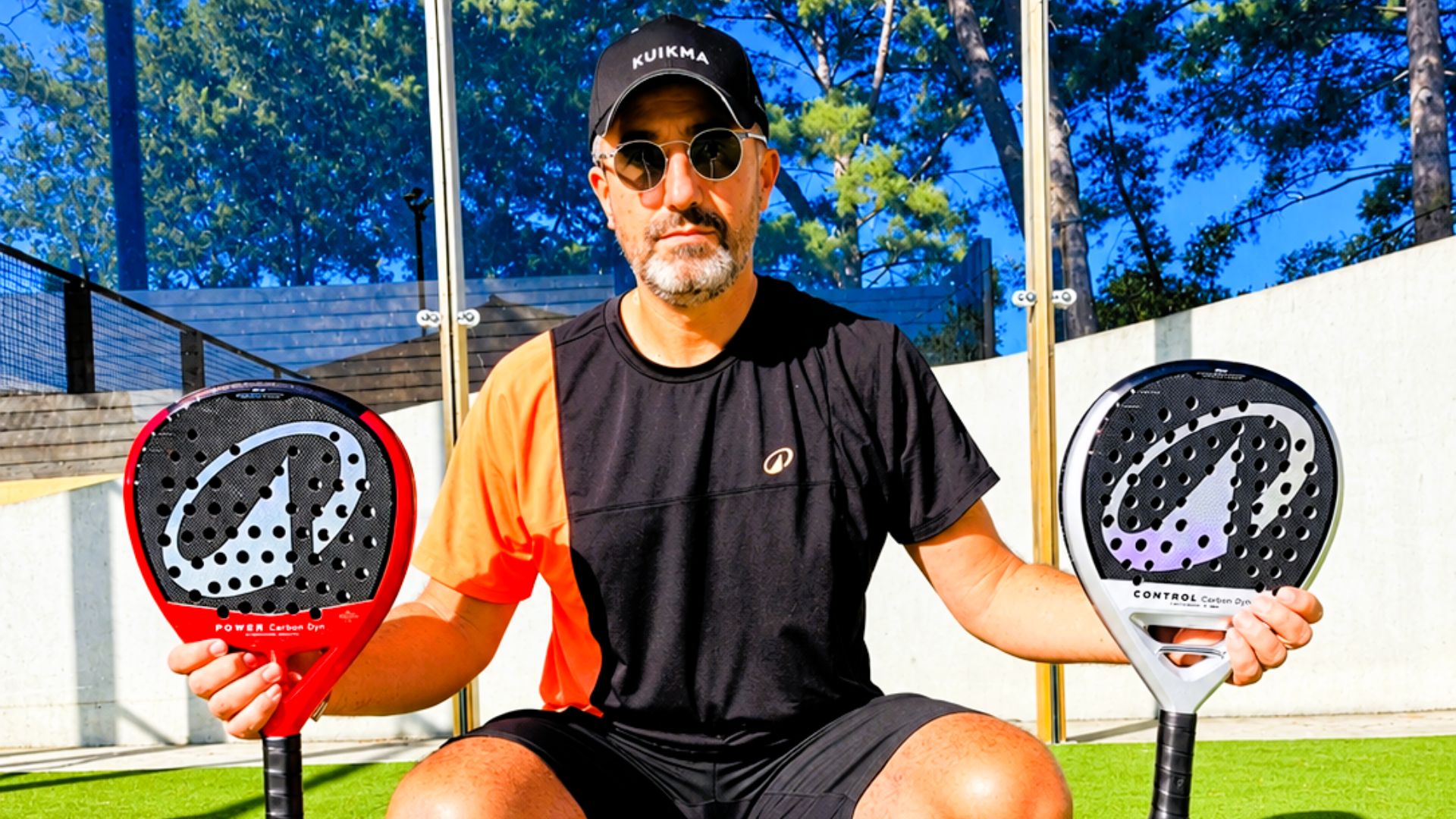







When you land on the padel tab of the Decathlon website, one thing immediately stands out: the catalog has become a veritable treasure trove! Clothing, bags, balls, shoes, accessories and, of course, rackets… absolutely nothing is missing. With Kuikma , his brand entirely dedicated to 20 × 10The French giant has gradually established itself as a key player in padel equipment.
Over the years, the brand has learned to speak to all types of players, developing collections with distinct DNA. Following the ranges Carbon, Metal , or, more recently, Pro Here is the new generation Carbon “Dyn” .
Behind these different characteristics, the brand's guiding principle remains unchanged: to offer cutting-edge technical specifications. without blowing the budget all draped in a truly high-end look.
To find out what this new range is really capable of, let's head to the field for more than a month of intensive testing A test conducted in two radically different environments: under the summer sun of the outdoor slopes of Cassis , then in the more temperate and controlled environment of the indoor complex Cap 7 Padel in Marseille .
Two settings, two atmospheres, but the same objective: to push these three palas to their limits and understand what truly differentiates them.
A shared recipe, transformed behaviors
Before talking about power, control or sensations, we need to understand what lies beneath the paint.
Kuikma has chosen to build its models around a solid technological foundation: Twin Carbon Tube, Air Foam Frame, High Modulus Carbon 3K, Black EVA, Rough Surface all ingredients that have already proven themselves at the brand , now supplemented by the previously unpublished Dynamic Channel .
In other words, the differences between the three paddles are not simply based on a different color or shape. They also stem from how this matrix is used on the field.
And that's precisely what makes this range interesting to test: Using comparable technology, changing the shape, balance, drilling pattern, or architecture of the bridge can be enough to radically transform the personality of a pal .
High Modulus Carbon 3K
In the padel industry, there's a lot of talk about 3K, 12K or 24K But these figures only tell part of the story.
Here, Kuikma mainly emphasizes the mention High Modulus , or H Auto Module: a fiber designed to offer a maximum resistance to deformation .
Coupled with the tight braiding of the 3K, This design aims for a particularly direct behavior, with little feeling of float on impact and fairly clear feedback.
On the ground, this translates into a dry and legible touch , particularly useful when you need to block, counter or simply give a very precise direction to the ball.
The trade-off is quite logical: this type of response requires greater precision. A responsive paddle won't necessarily forgive an imprecise contact. On the other hand, when the ball is well centered, the feedback is very clear.
Twin Carbon Tube: lock the frame
The second element common to all three models is the Twin Carbon Tube .
Kuikma uses a double carbon tube here to form the peripheral frame of the paddle. The aim is to reinforce the torsional rigidity of the frame and to limit unwanted movement during off-center shots.
This is a particularly interesting point in padel. On a counter taken at the end of the run, a reflex volley or a slightly off-center defensive shot, the stability of the frame directly contributes to the feeling of control.
The idea is therefore not simply to obtain a "rigid" paddle. It is primarily about maintaining a certain behavior. stable and consistent when the typing is not perfect.
Air Foam Frame: Foam where you least expect it
The Air Foam Frame completes this architecture.
Kuikma injects structural foam inside the carbon tube. This foam contributes to the stiffening of the structure while also helping to to dampen some of the vibrations generated during impacts.
This allows us to work on two fronts: frame strength et vibration filtering .
And that's precisely where the combination with high-modulus carbon becomes interesting. You can maintain a fairly crisp response to impact without necessarily ending up with an excessively harsh feel.
Black EVA: the conductor
At the heart of the pala, there is a foam Black EVA presented as a dense and stable gum.
Choosing a core of this type gives a relatively predictable response, with little sensation of flutter when playing at reduced speed.
The foam, therefore, does not seek to do all the work for the player. It merely assists the acceleration when the arm is engaged.
This is particularly interesting in phases where padel requires a sudden shift from a build-up game to an acceleration: bandeja shot, vibraboo shot, glass exit or smash .
Rough Surface: a very subtle relief
Finally, all three models benefit from a Rough surface , materialized by a 3D honeycomb finish.
On paper, the mission is clear: to provide more grip on the felt and to support the production of rotation on sliced strokes.
But let's be completely clear-headed, racket in hand: the terrain is particularly flat As soon as you run your fingers over the sieve, you immediately feel that it remains very discreet, almost flush with the surface.
The direct consequence on the court: don't expect the bite of a highly aggressive sanded finish. This surface can complement the player's technique, but it won't, on its own, transform a standard ball into a spin machine.
On the other hand, choosing a relief integrated into the finish has a clear advantage: The texture does not depend on a simple surface sandblasting that could wear out quickly. .
And as is often the case in padel, the surface will never do the work for you. To make the ball fly off the glass or die in a corner, you'll primarily have to rely on your racket head speed, your positioning and the quality of your stroke .
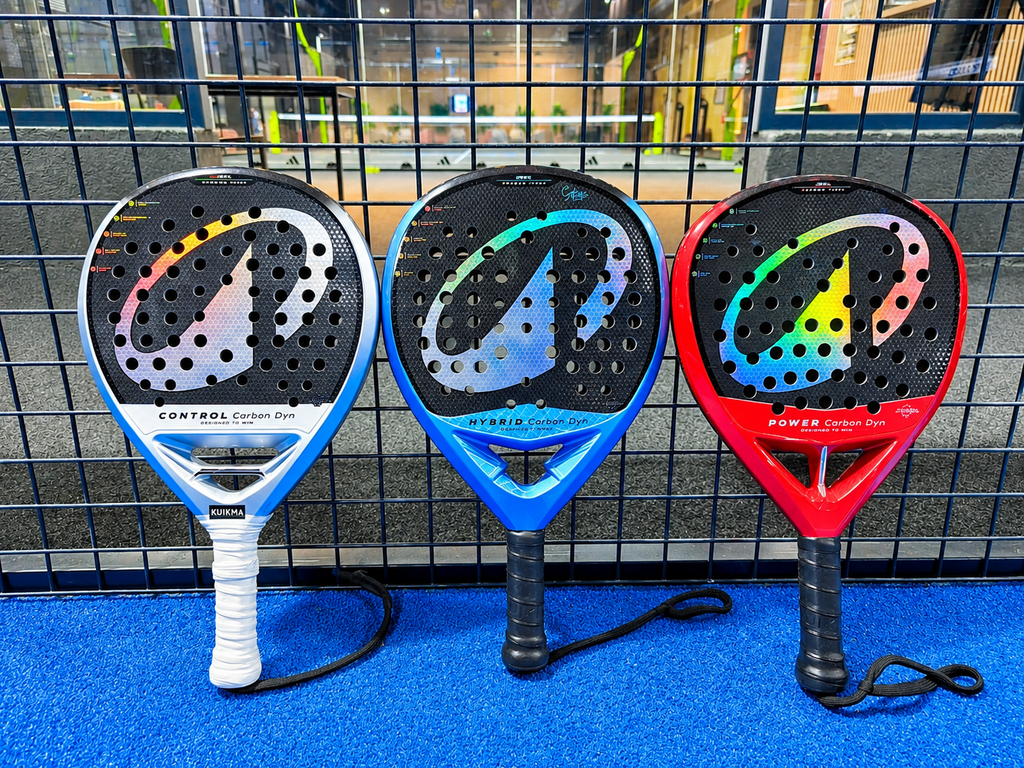
The drilling plan: much more than just a visual detail
At first glance, the drilling plan It seems to be just a matter of the distribution of the holes. Yet, it directly contributes to the character of a pala.
The area where the holes are absent corresponds most likely in the prime area of the sweet spot It is located rather high on the diamond shape , slightly lower on the hybrid while she appears more centered on the round .
The key word here is indeed "probably": without manufacturer data on the exact distribution of mass or rigidity, we are talking about a reading geometry , not an absolute truth.
This feature is not insignificant, however. By removing material from certain areas and retaining it in others, the manufacturer alters how the surface behaves locally upon impact, with potential consequences for the rigidity , the mass distribution and the sieve response .
The drilling pattern also contributes to the overall behavior of the pala, just as the architecture of the bridge which we will detail a little later.
And that's precisely where the comparison becomes interesting: Based on the same technological foundation, same core, same coating, same materials, two paddles can offer different sensations and reactions simply because of their geometry and drilling pattern.
Dynamic Channel: the new product
In this range, which owes its name to him, the major innovation that characterizes this new family is the Dynamic Channel .
In practical terms, it's a groove carved directly into the frame profile to optimize aerodynamics. This profiling allows for the announcement of a Effort savings of up to 7% during explosive phases , which immediately translates on the court into a more fluid swing and a valuable head start during reflex duels at the net.
In padel, the player doesn't just make big swings. He spends his time repositioning the racket face within extremely narrow windows: reflex volley, block, exit from the glass, change of grip, preparation for a vibora or regaining footing in defense .
In these situations, the ease with which the pala head moves can really make a difference.
The Dynamic Channel was not designed as a power multiplier. Its real strength lies elsewhere: fluidize the movement of the sieve to free the arm in its accelerations.
Coupled with a claimed weight of less than 360g, the bias is obvious: to prioritize maneuverability and responsiveness.
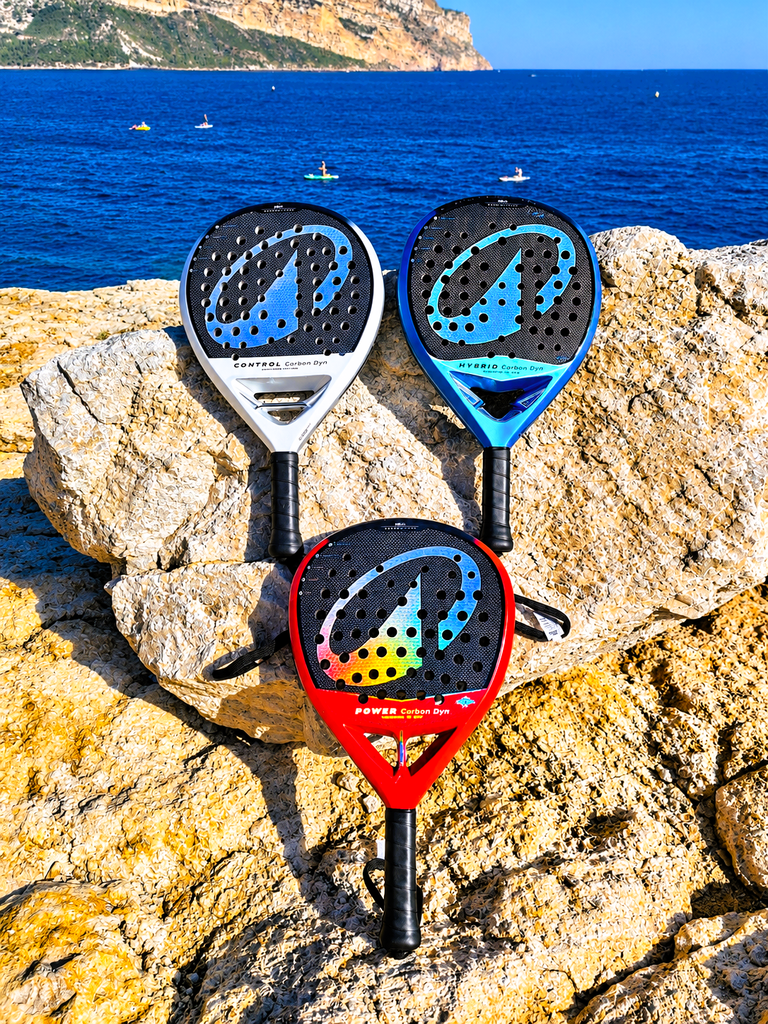
Control, Hybrid, Power: the holy trinity according to Kuikma
At Kuikma, they avoid convoluted marketing names and get straight to the point. To identify each model, the catalog uses the prefix PR simply meaning Padel Racketeering , a simple and straightforward identification code, very characteristic of the Decathlon method.
Around this central theme, the brand avoids unnecessary complications and develops its collection around three profiles with perfectly defined roles:
- PR Control: surgical precision, immediate maneuverability and absolute mastery of tempo.
- PR Hybrid: the delicate balance, the ideal compromise between defensive security and offensive sharpness.
- PR Power: maximum leverage, impact zone perched at the top and the search for heavy power.
Three distinct philosophies of play, which nevertheless rest on a strictly identical technological base But as we shall see, the shape of the frame , the drilling plan , mass distribution et the specific architecture of the bridge radically transform the character of each woman once she's on the track.
And that's precisely where the test with the racket in hand becomes exciting.
Control Carbon Dynamic: precision above all
With its rounded silhouette, the PR Control It sets the tone right from the start. Without falling into the usual trap of automatically associating "round shape" with a necessarily head-light balance or a necessarily centered sweet spot, it's clear that Kuikma has sought this consistency here: a contained center of gravity to reduce inertia and a very well-balanced calibrated impact zone at the heart of the sieve .
On paper, the proposition is a perfect fit for players who favor patient build-up play, transitional play, and surgical control of tempo. But as always in padel, it's with the racket in hand, facing the real rhythm of the court, that this promise of control must prove itself.
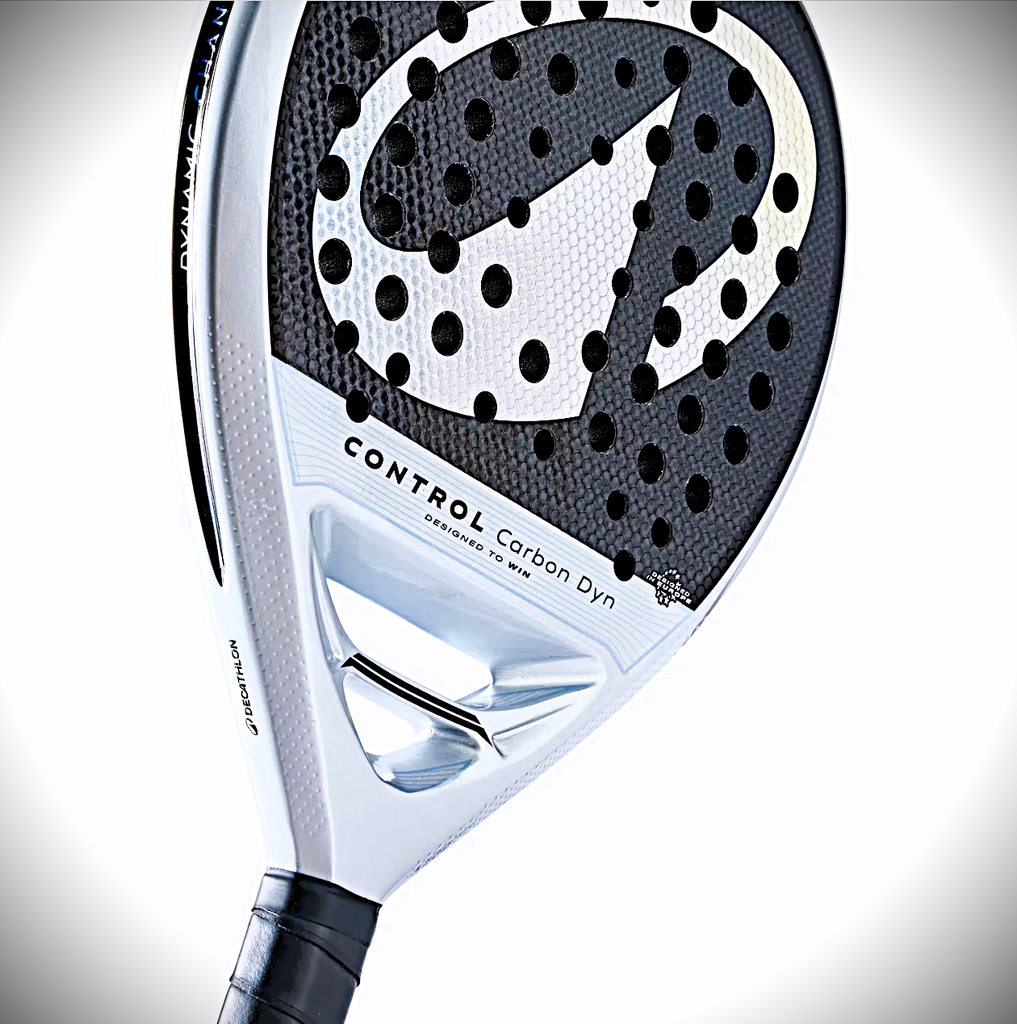
A steel grey & liquid titanium dress
In line with its recent visual successes, Kuikma confirms its impressive maturity: with this Dynamic range, the brand pushes the boundaries of refinement and detail one step higher
As soon as you take the pala out of your bag, The upgrade in quality is immediately obvious. . We find a much more formal visual language, where the different materials, textures and finishes have been particularly carefully considered.
The common thread of this trilogy It is based on a balance between raw technicality and premium finish:
- The visible 3K carbon: The carbon weave remains visible over a large part of the racket face, with this geometric pattern that immediately gives the racket a technical look.
- The central iridescent logo: This is clearly the centerpiece of the design. It features a honeycomb pattern that plays with the light. Depending on the angle, the reflections shift from copper to gold, sometimes with cooler undertones. The chameleon effect works particularly well under spotlights.
- The ultra-clean graphic details: The technologies are discreetly listed on the top of the frame via small dots, while the lower part of the sieve receives a geometric pattern that accompanies the model name.
On the Control, this canvas It is adorned with a metallic steel grey that runs along the entire lower part of the frame and wraps around the bridge crossbar.
The result is particularly successful: understated, technical and precise, with a real personality There's almost a surgical precision to this finish. A paddle that doesn't try too hard, but knows exactly what it wants to achieve.
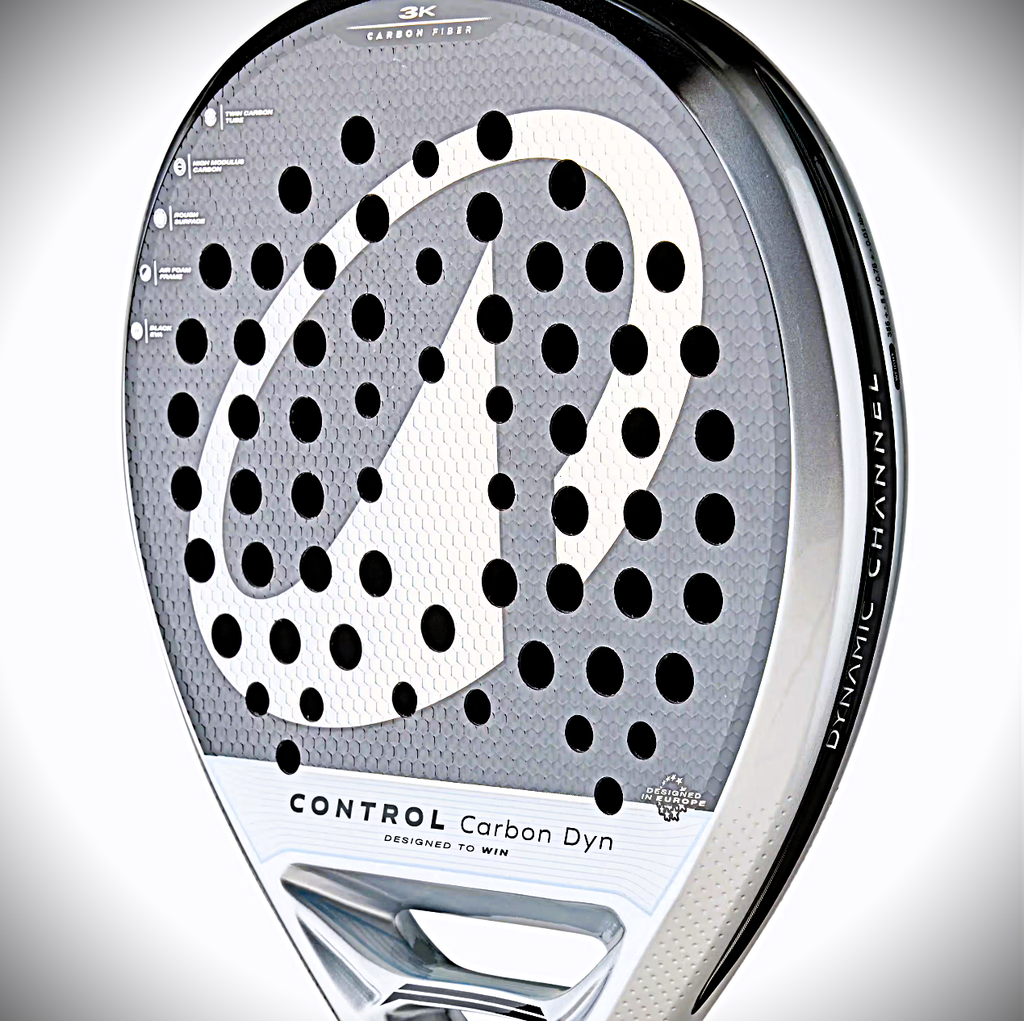
The bridge: a horizontal reinforcement bar
While the foam and the faces are the driving force of the pala, the pont The core, or heart, plays a significant role in its structural behavior. It is notably what connects the handle to the sieve and contributes to how the whole assembly reacts under stress.
Therefore, the choice not to use exactly the same bridge architecture on all three forms of this Dynamic range makes perfect sense: The overall geometry of the paddle does not change on its own; the core also evolves with it.
On the Control, the heart is visually marked by a horizontal crossbar .
It is impossible, however, to claim on its own that it "lowers the balance" or that it "filters" precisely this or that frequency. What we can observe is that this architecture contributes to giving the pala a structural identity different from those we will see later.
Stake
And it's precisely on the track that this Control becomes interesting.
From the very first shots, it gives that very particular feeling of a paddle that don't try to take control of the movement for you .
It's probably on defense that she best reveals her character. When she has to absorb a fast ball against the glass or return a tricky ball to a specific area, her maneuverability allows for quick repositioning of the sieve.
The round shape also helps when the contact isn't perfectly centered. The striking area feels more reassuring, especially when the pace picks up and you have to improvise.
But the Control is not a soft or passive paddle by any means.
Le High Modulus Carbon 3K retains this relatively dry and direct feel. On a chiquita, a short ball or a placed volley, the feedback is immediately perceptible.
This is where the marriage between round shape, high modulus carbon and Black EVA becomes particularly interesting: the paddle offers a certain tolerance in its positioning while retaining a sufficiently crisp response to work the ball with precision.
At the net, it favors the construction of the point than the search for the immediate winning move.
You can accelerate a volley, close an angle, play at the feet or change rhythm abruptly, but the pala never gives the impression of wanting to transform each shot into a missile.
Moreover, while the sound can become rounder and more muted in the small game and transition phases, the overall effect changes radically. As soon as you rev the engine: the impact becomes particularly sharp, I love it! It's a clean, crisp hit, with that immediate honesty that makes you want to hit the ball harder and harder.
On smashes, the experience is obviously different from what one would expect from a Power version. More physical effort and arm speed are required to generate weight, but make no mistake: in the right hands, it's incredibly powerful.
But that's also what makes it interesting.
For a player who likes build before accelerating Defending properly, regaining possession of the net and making the opponent work rather than seeking the winning point with every shot, this restraint becomes a true quality.
Control rewards skill and game reading more than brute force.
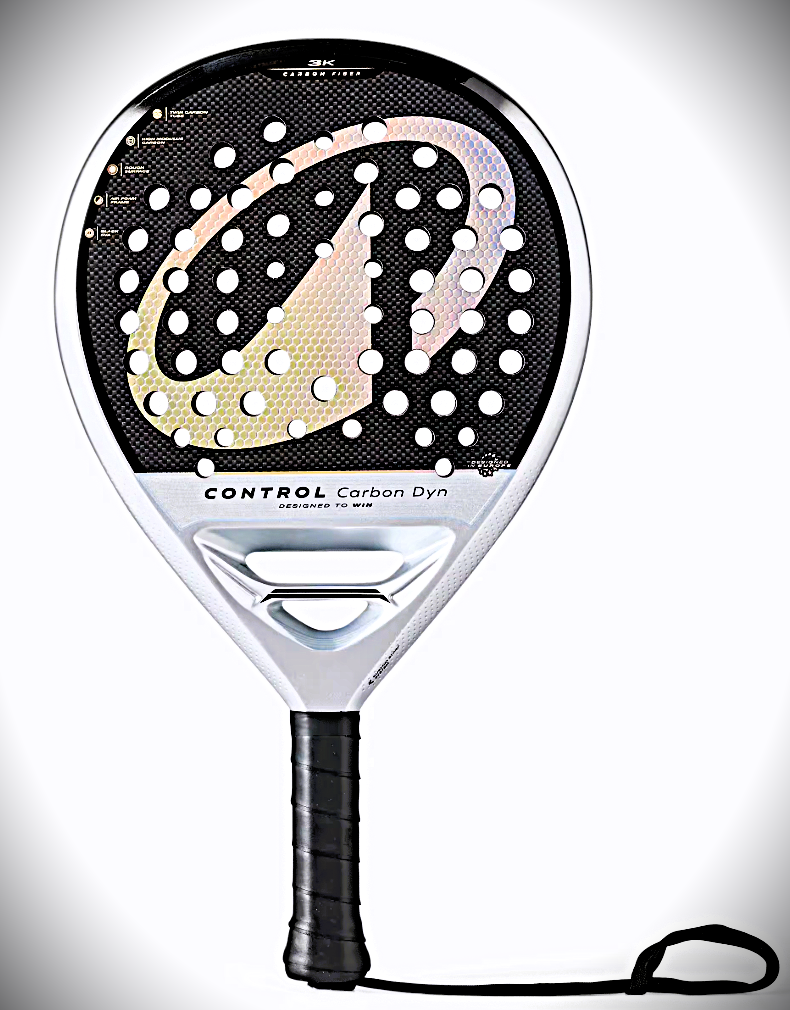
The first impression is already revealing.
That's it for this first pala, and it already sets the tone: With comparable technology, the shape and architecture of the bridge are enough to tell a completely different story once the ball is in the sieve.
La PR Control Carbon Dynamic This shows that a paddle made with high-modulus carbon and a dense core is not doomed to become a brute force tool. On the contrary, its round geometry, maneuverability, and overall design result in a precise, stable, and enjoyable racket to use when constructing points.
But this first chapter is only just beginning.
Now we just have to see what this same base yields. Twin Carbon Tube, Air Foam Frame, High Modulus Carbon 3K, Black EVA, Rough Surface and Dynamic Channel once it was poured into more offensive molds.
With its teardrop shape, the Hybrid promises to play the balancing act between control and attack. With its raised diamond shape and its balance more oriented towards the head, the Power She, however, openly embraces the pursuit of power.
Let's move on to the second part of this test bench to find out if these two paddles really live up to their respective promises.

Padel fan, Stéphane has become the official tester of the padel planet in Europe. Everything goes through his expert hands. Thanks to his extensive experience in the world of rackets, he is able to scan your equipment from head to toe!












































 P1000 Verneuil: Gortzounian/Vignat cruise, Bisiaux/Daumont knock down TS2 to reach the final
 P1000 HUDDL Aizenay: Henrion and Mitjana maintain their position, Prod'homme/Marin overturn Truong/Dulac to reach the final
 P1000 Ladies My Padel Langon – Denecheau / Majdoubi and Vandaele / Dautriat dispatched quickly in the semi-finals
 France or Portugal, Spain or Argentina: Miguel Lamperti ranks the best padel nations
 Cédric Lavoye: "Hard work pays off" and a first FIP tournament in Guadeloupe is in his sights
 Nicolas Rouanet is preparing his return in 2027: “With Bastien Blanqué, I would never say no”
 Leygue/Blanqué respond bluntly to the criticism: "You can say what you want... We're putting all our money and our lives into this."
 Padel rankings October 2026: more than 150,000 men ranked in France
 P1000 Verneuil Padel Club – Results / Live / Schedule
 West Padel opens its 4 indoor courts in Montivilliers on November 5th
 With Galán tired and Coki Nieto sidelined, is the infernal pace of the circuit starting to take its toll on the players?
 Milan P1: Thomas Leygue launches his qualifying campaign with Jesús Moya
 Germany P2: The fastest quarter-finals in history Premier Padel
 Zidane and Galán reunited on the track to launch the Metalbone ZZ
 For sale: two padel clubs in Mauritius, starting from 330,000 euros
 How much does it actually cost to organize a FIP Bronze event?
 Padel How Lidl is transforming Crivit into a fully-fledged sports brand with Steffi Graf
 Compagnie des Alpes is accelerating its involvement in padel with PadelCity: a new step in its European strategy
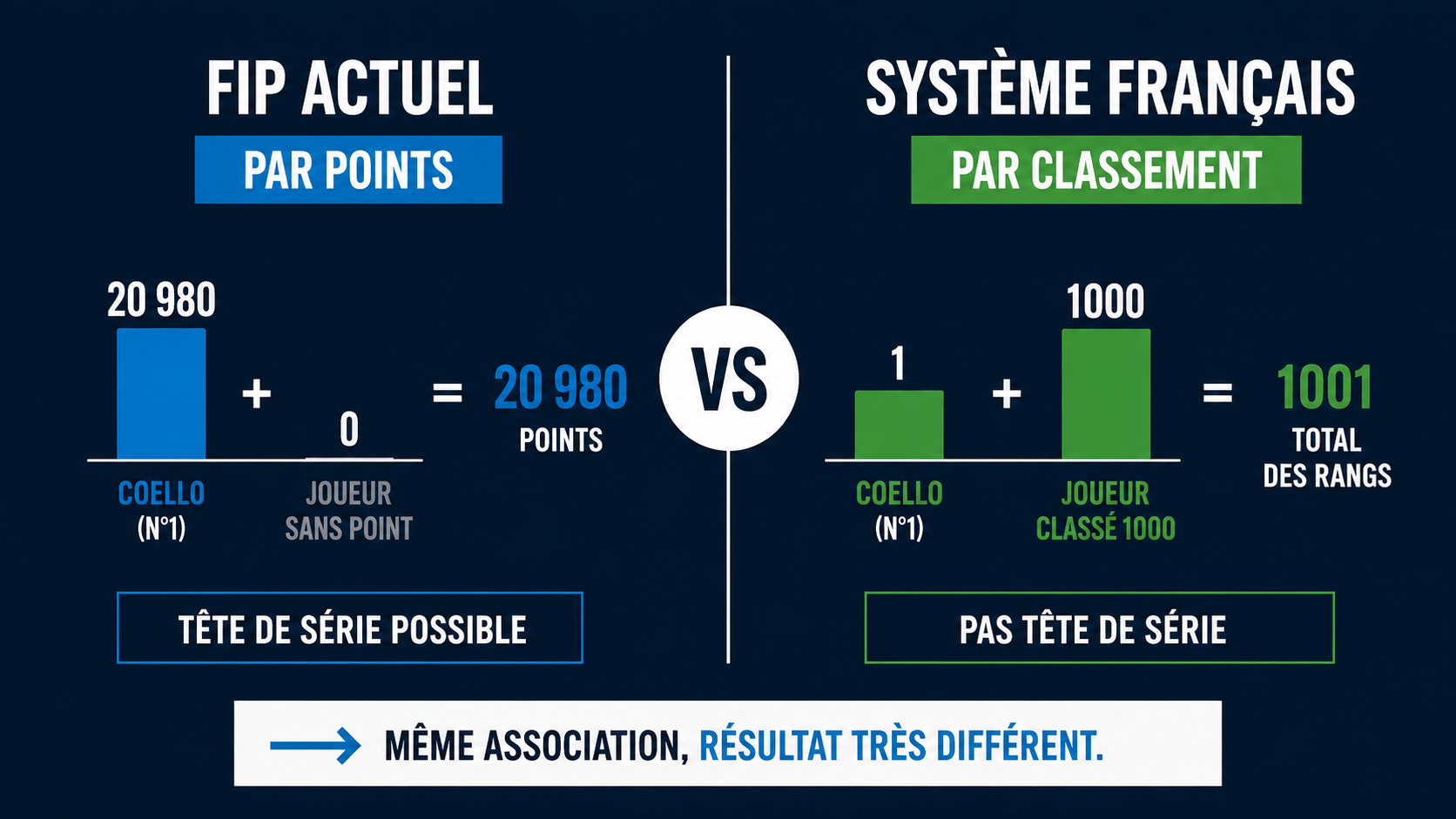 Coello with a player at 0 points ahead of two top 10 players: should the FIP ranking be reviewed?
 Les Pyramides: after 12 padel courts, the club is focusing on youth training
 Health Care Padel Tour 2026: What if your next padel tournament was played in Barcelona?
 FAST Padel Academy continues its development and establishes itself in Liège.
 What the analysis of the stroke reveals: tennis forehand vs. padel bandeja
 Has the bandeja disappeared from modern padel?
 Flat forehand in padel: 5 exercises from Cristian Álvarez to gain control and efficiency
 Why knowing how to play on the right and left can make all the difference
 Tapia reveals his recipe for beating Coello / Tapia: "I would bet everything on myself"
 How Coello defused Chingotto's game plan
 In padel, does the chemistry between a pair count as much as individual skill?
 Summer changes padel… but what if the real challenge wasn't hitting harder?
 Neither FIP Tour nor World Team Championship: the unique format of padel at the Mediterranean Games
 Premier Padel : when television can lengthen players' breaks
 Premier Padel Yes, a referee can refuse a player permission to go to the toilet
 Julien Seurin opens up about his mental state: "There are far more doubts than moments of happiness."
 More than a year later, Thomas Leygue is back in the top 150: behind the scenes of a comeback that's still unfinished
 Padel vs squash vs badminton: the scientific ranking of cardio intensity
 Why does Arturo Coello play with his right hand bandaged?
 What if your progress in padel depended on what nobody else is looking at?