

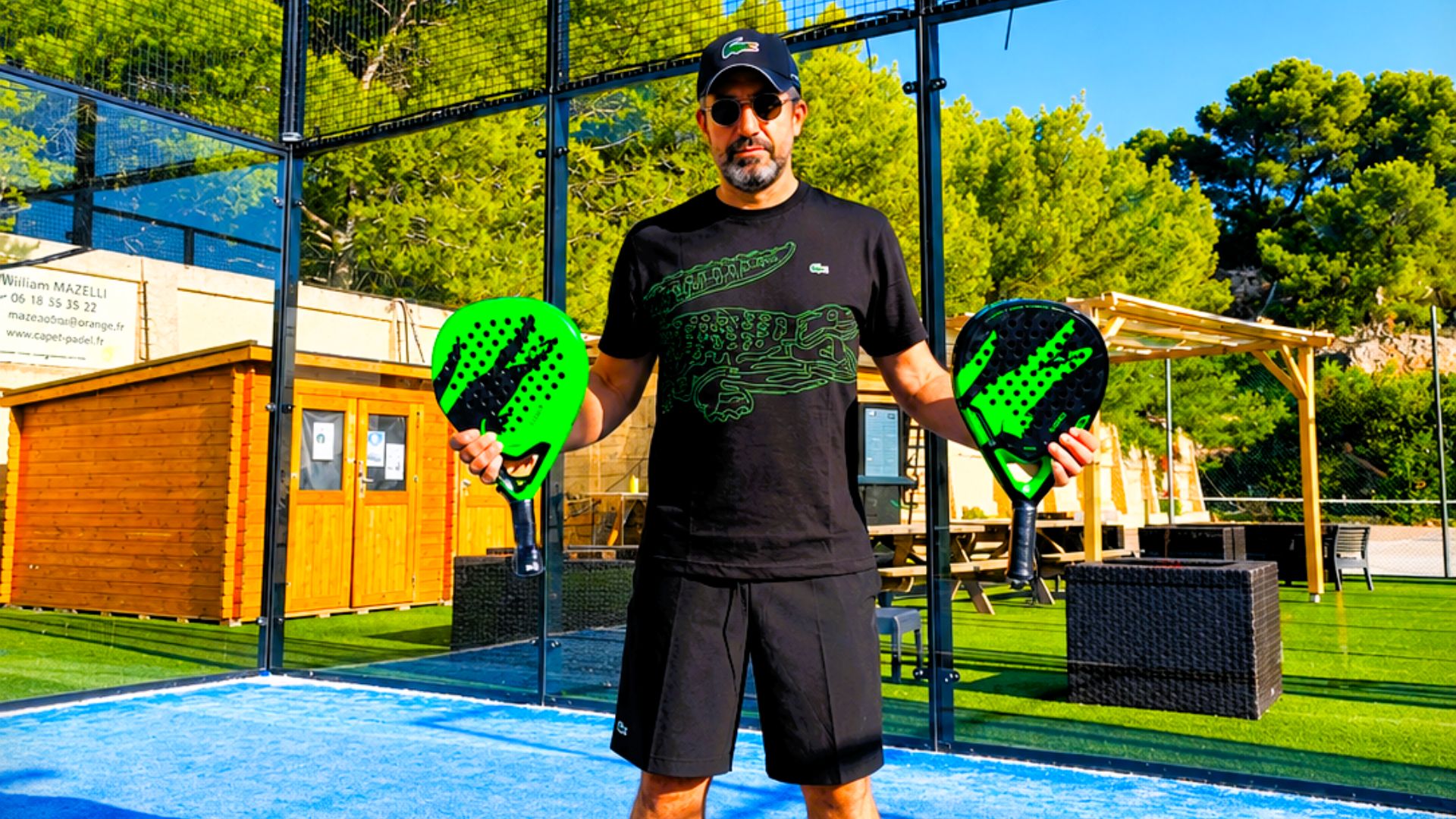








There are rendezvous with history that such an iconic brand cannot miss. Founded in 1933 by René Lacoste For nearly a century, the crocodile brand has cultivated a special relationship with racket sports, blending elegance, innovation, and sporting excellence. As padel continues to grow in popularity, it's hard to imagine Lacoste remaining forever detached from this phenomenon.
For this first foray, the brand has a major advantage: Tecnifibre , a French specialist in racket sports that came under its control in 2017. The two entities thus share complementary know-how, between technical expertise and research and development on one side, and visual identity and sporting heritage on the other.
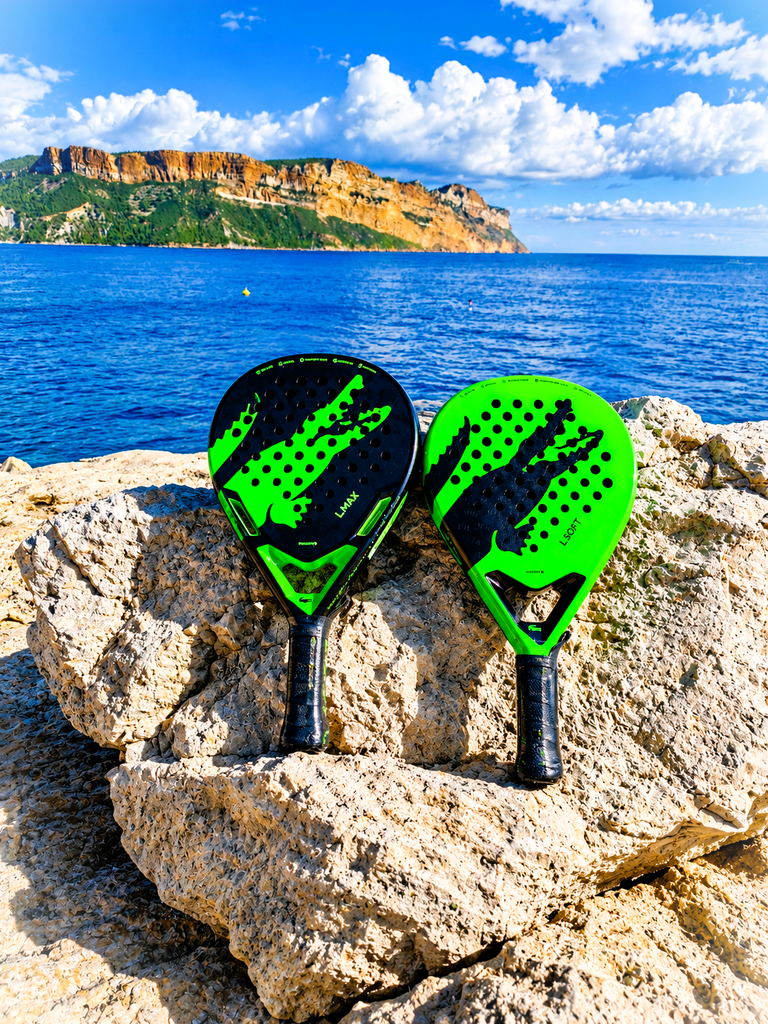
It is in this context that the first two palas bearing the famous reptile arrived: the Lacoste L.MAX and L.SOFT .
And for this baptism of fire, there's no question of starting from scratch. Those familiar with the Tecnifibre catalog will quickly recognize the similarities with the Curva family , whose two models feature a familiar architecture, dressed in a resolutely Lacoste identity.
A pragmatic choice, far from meaningless. Rather than to multiply innovations To make a lasting impression, the brand prefers to rely on on an existing architecture and offer two models with very distinct temperaments.
Cosmetics: The Crocodile shows its teeth
L.MAX: a setting worthy of the house
Upon receipt of the L.MAX It is understandable that Lacoste does not want to offer a racket like the others.
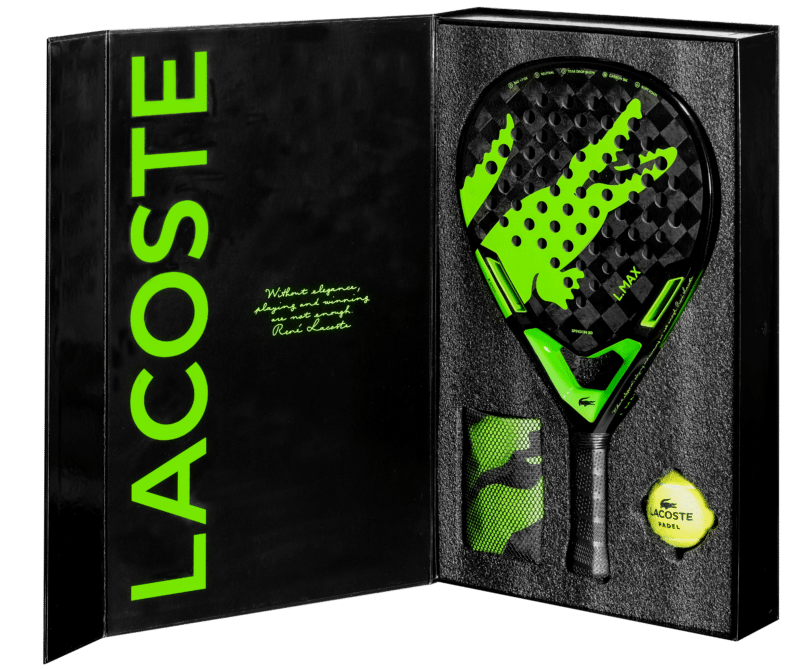
The model is presented in a true black collector's box neatly compartmentalized, which also contains an exclusive cover and a stamped ball Lacoste Padel . Particularly careful packaging, which transforms the simple unpacking into a small ceremony.
Upon opening, a calligraphed inscription in green immediately catches the eye:
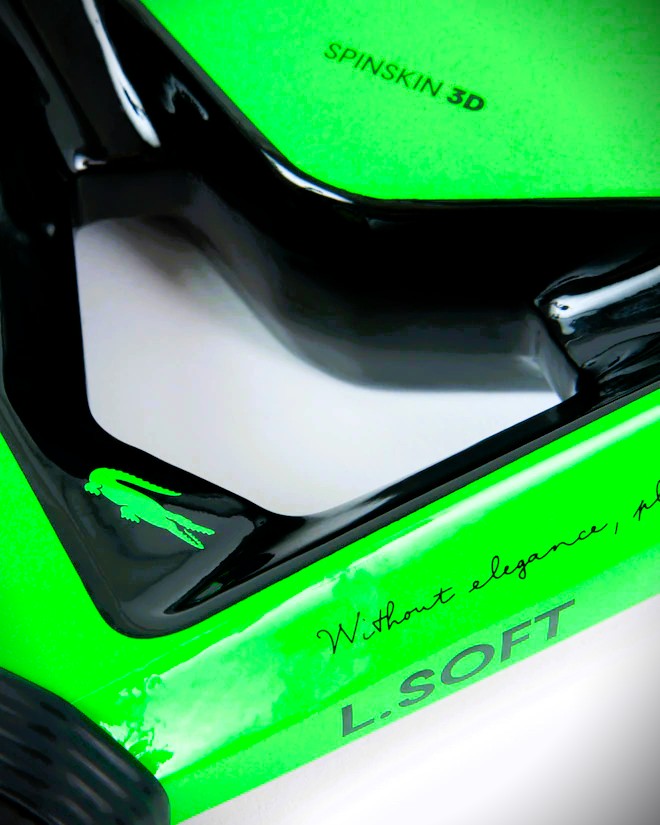
“Without elegance, playing and winning are not enough. » — René Lacoste
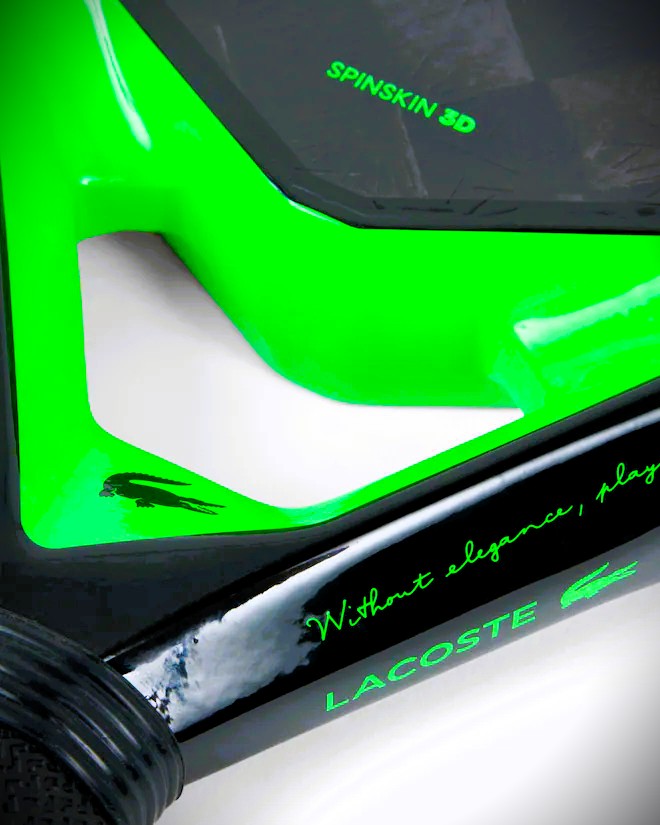
This motto, which is also found on the edge of both rackets, perfectly sums up the spirit of the house: Victory matters, but so does the way you achieve it. .
One remark, however, with a slight hint of chauvinism: why choose English for such an emblematic maxim? When one has represented French elegance for so long, the language of Molière would have been perfectly suited to this setting.
Let's move on to the racket.
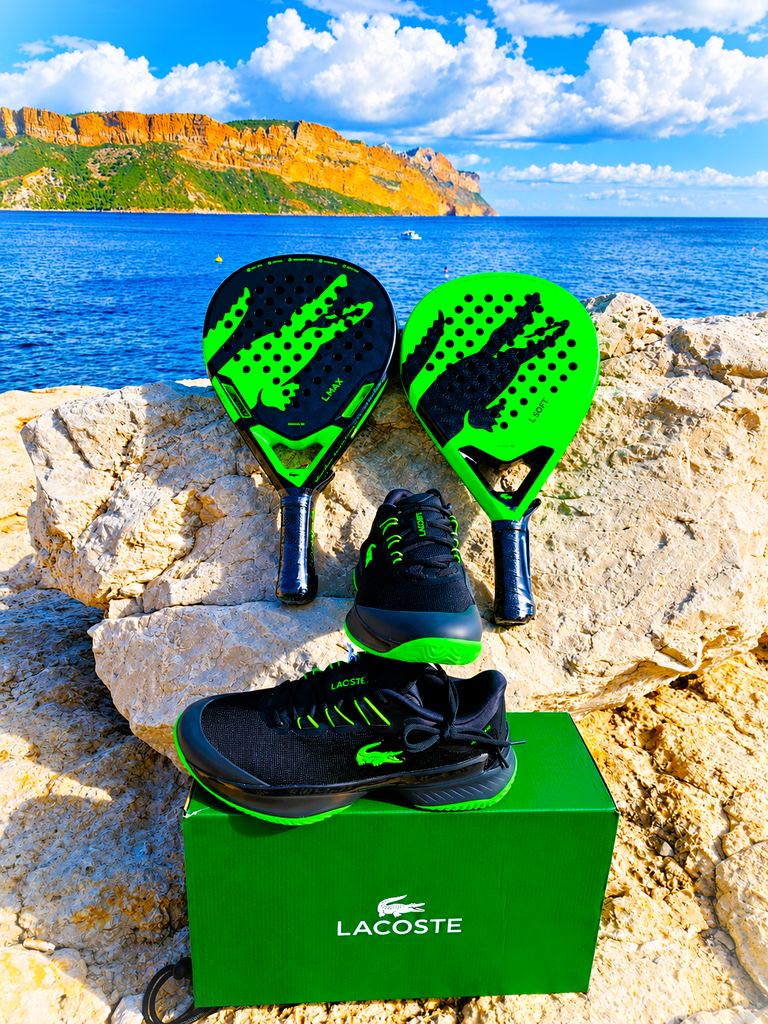
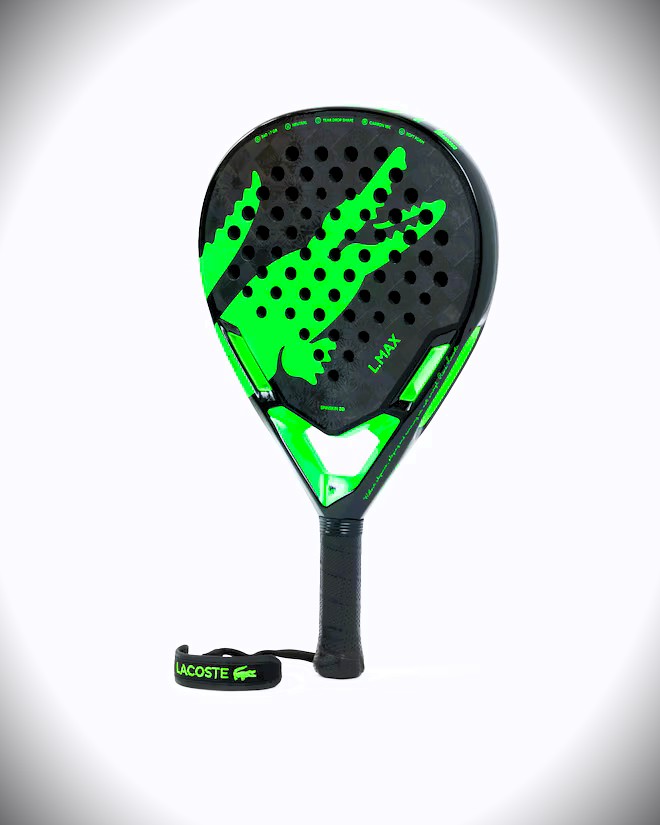
La L.MAX sports a superb black lacquered , with a glossy finish that reveals a carbon checkerboard weave The result is particularly successful: the visual relief adds depth, while the fluorescent green awakens this dark dominant color.
The famous crocodile occupies a large part of the sieve. Impossible to miss: the reptile clearly displays its ambitions.
L.SOFT: the colors are reversed
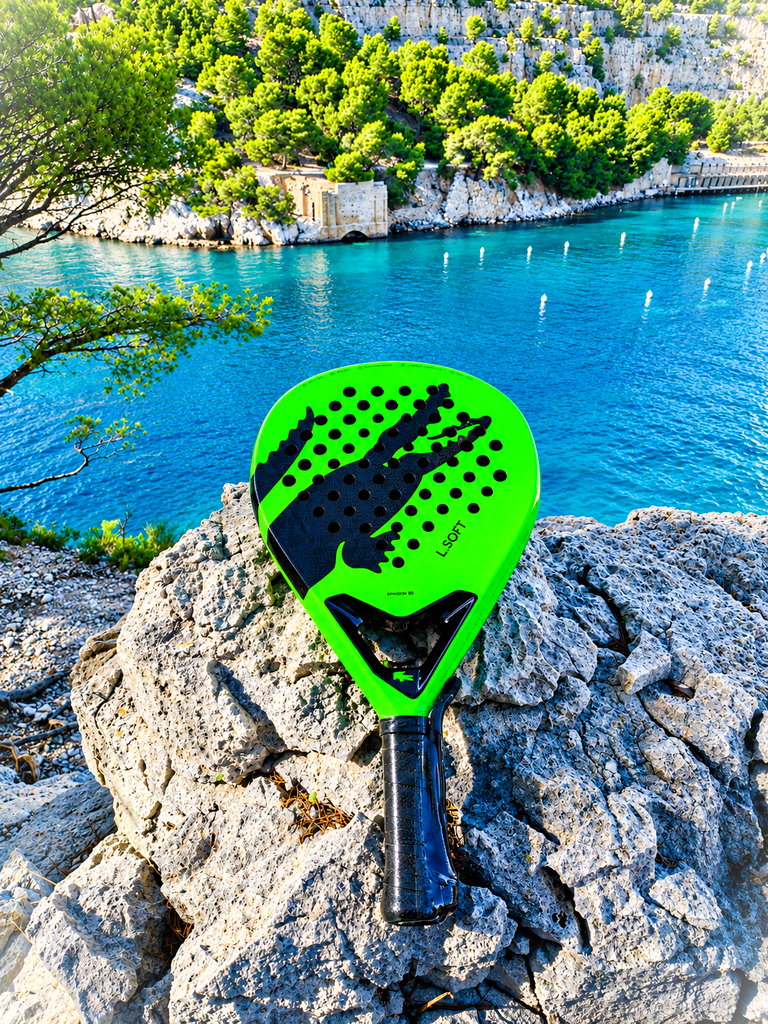
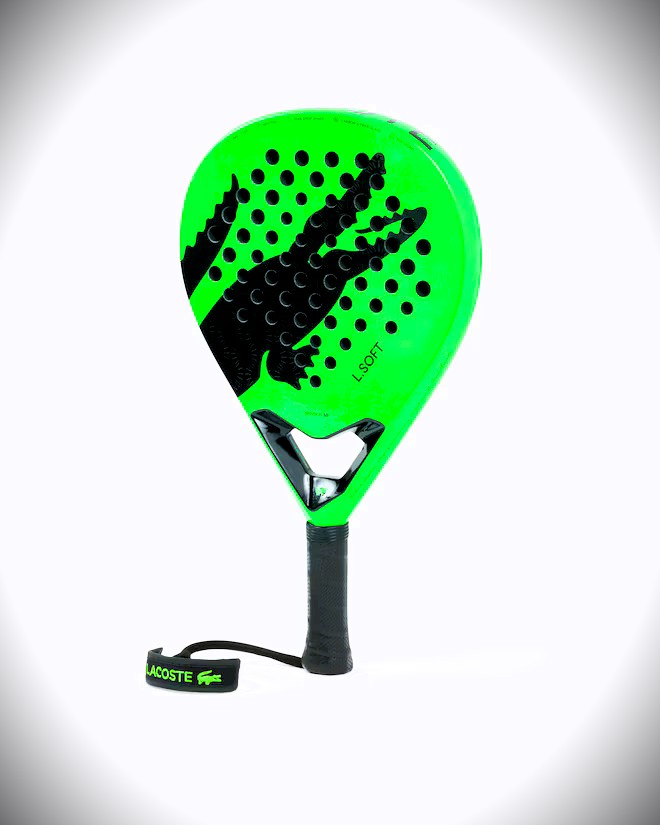
La L.SOFT It uses the same aesthetic codes, but completely reverses the colors.
Here the bright green becomes omnipresent. It covers almost the entire front and frame, while the crocodile is drawn in deep black, with a textured effect that contrasts nicely with the glossy varnish.
The result is much more striking than on the L.MAX. A vibrant, almost summery aesthetic that certainly doesn't go unnoticed on the track.
The finishing touches are equally impressive: inscription L.SOFT discreetly integrated, René Lacoste's maxim on the edge and fleece strap embroidered in the brand's colors. This last detail deserves to be highlighted, as it's so pleasant to find a neat wrist strap right out of the box.
But one aesthetic choice leaves me wanting more: the size of the crocodile .
Was it really necessary to give him so much space?
Lacoste built a global reputation with a small embroidered patch on the chest. An instantly recognizable signature, without needing to do anything more.
In my opinion, A more discreet crocodile would have better embodied the historic elegance of the house. The XXL logo will certainly appeal to fans of bold designs, but I find that it lacks a bit of the restraint that is precisely what makes Lacoste products so charming.
It obviously remains a matter of personal taste. And it's hard to deny that these two palas possess a particularly strong visual identity.
Beneath the surface: the Tecnifibre Curva legacy
Beyond the aesthetic appeal, let's look at what these rackets are really capable of.
The relationship with the Tecnifibre Curva It quickly becomes apparent. The shapes, the architecture of the frame, and the technical solutions all demonstrate a clear connection to this family, designed to combine versatility, maneuverability and offensive potential .
This partnership should be seen as an advantage rather than a weakness. Lacoste is building on an already established foundation, without artificially multiplying innovations to justify its market entry.
One particularity, however, deserves to be highlighted.
In his communication, Lacoste presents both models as diamond-shaped rackets The Tecnifibre Curva, to which they are similar, are generally presented in a more versatile register, with a geometry close to that of a water droplet.
This difference in classification does not necessarily mean that the molds are radically different. It also reflects how each brand wishes to position its products.
Upon examination, we are not dealing with extreme diamonds exclusively intended for high rollers, but rather with profiles capable of combining acceleration capability and ease of handling .
Let's now see what distinguishes the two versions.
L.MAX: Power without excessive rigidity
La L.MAX constitutes the most offensive proposition of this first duo.
Its main selling point lies in its surface area. 18K carbon , associated with a foam EVA Soft one-piece .
This combination is interesting. The carbon contributes to the firmness and responsiveness of the face, while the softer foam aims to preserve comfort and ball exit.
However, be careful not to fall into the trap of commercial names: the 18K This information indicates the number of filaments making up the carbon fiber strands, but it is not sufficient on its own to determine the final stiffness of a racket. The orientation of the fibers, their quantity, the resin, and the overall construction also play a major role.
So, on this L-MAX, it's good the combination of all the materials which gives the pala its character.
X-Speed: an architecture designed to accelerate
The L.MAX inherits the technology X Speed , from the Tecnifibre universe.
This device is characterized by openings made in the frame structure, designed to facilitate the passage of air and to accompany the accelerations of the racket head.
The idea is interesting: reduce aerodynamic resistance to promote quick preparations and explosive movements.
Of course, it remains to distinguish the technical promise from the actual experience. Aerodynamic design alone is not enough to guarantee better handling: mass, its distribution and overall inertia remain crucial.
X-Top and Spin Skin 3D: protection and effects
Two other technologies complete the equipment.
La X-Top offers a solution for reinforcing the upper part of the frame, designed to better withstand accidental contact with the ground, windows or wire mesh.
La Spin Skin 3D Meanwhile, it adds texture to the surfaces to improve ball grip. A treatment that will be of particular interest to players who appreciate... cut bandejas, the víboras and the worked strikes .
On paper, the L.MAX boasts impressive hardware. But what interests me more is its ability to utilize these technologies without becoming too demanding to play.
L.SOFT: Speed as a priority
La L.SOFT takes a different path.
Lighter than 15 grams It prioritizes immediate handling and greater ease of movement.
Its construction combines 80% fiberglass and 20% graphite with a foam EVA Soft .
This combination is based on a principle of flexibility and comfort. Fiberglass generally provides a more elastic feel than some carbon-dominated constructions, while the soft foam supports the ball's rebound.
The goal is clear: to offer a racket that responds easily, even when the player is not hitting at full speed .
L.SOFT retains the technologies X-Top et Spin Skin 3D but overlooks the device X Speed present on the L.MAX.
A slightly simpler piece of equipment, then, but perfectly consistent with its positioning.
A surprising, but well-thought-out balance
One detail particularly deserves my attention: The L.SOFT has a slightly higher balance than the L.MAX .
On such a lightweight racket, this choice makes perfect sense.
A balance point too close to the handle could give the impression of a very light head, with less presence at impact. Here, the mass distribution allows for a certain consistency in the stroke, without excessively compromising maneuverability.
That's precisely what I find on the track: A lively pala, easy to accelerate, but which retains enough responsiveness to avoid giving the impression of swinging at thin air. .
This compromise is particularly appreciated when you need to defend, pick up a low ball or find depth without using your whole arm.
The L.SOFT doesn't aim to compete head-on with the most powerful rackets on the market. It prefers to make the game more natural, more fluid, and less restrictive.
And in this respect, she has strong arguments.
At stake: two very distinct temperaments
After the technical aspects, let's get to what really matters: the sensations on the track .
And despite their obvious similarities, the two Lacoste brands display sufficiently different personalities to justify their coexistence.
L.MAX: responsive, but also comfortable
With the L.MAX I'm finding a racket that loves to be used.
When I decide to launch a volley, to accelerate a viper Whether you're aiming for a smash finish, it responds with candor. The face is responsive and the impact has that consistency that you appreciate when the pace picks up.
But what pleasantly surprises me is that it is not limited to an offensive register.
Despite its construction in 18K carbon The L.MAX retains a appreciable comfort and very convincing maneuverability. It doesn't give the impression of being an excessively rigid racket that you constantly have to force to get anything out of it.
At the net, she is sufficiently available to hit volleys in quick succession without expending excessive energy. From the baseline, her response remains sound and allows her to build rallies without constantly chasing the winner.
It is ultimately a more versatile paddle than its name might suggest.
She likes it when you press the ball, but doesn't force you to play with force on every shot.
L.SOFT: an excellent surprise
La L.SOFT I was immediately impressed by its maneuverability.
Lighter than 15 grams It moves with remarkable ease. Preparations are quick, changes of direction are natural, and defensive reactions require less effort.
But its main strength is not limited to this liveliness.
I discover a excellent ball release , associated with a particularly generous sweet spot Even when the centering is not perfect, the response remains pleasant and the ball rebounds with appreciable ease.
In defense, this is a real advantage. Off-camera clearances are handled calmly, lobs require less commitment, and tricky passes become easier to manage.
At the net, this freedom of movement allows for quick sequences of movements and maintains a high quality of stroke, especially in tense exchanges.
Another pleasant surprise: despite its reduced weight, the L.SOFT doesn't lack responsiveness. Its slightly higher balance point gives it that extra presence that avoids the sometimes overly light feel of some comfort-oriented rackets.
It obviously doesn't have the same authority as the L.MAX when you're trying to finish a point with a heavy shot. However, it compensates by its liveliness, its tolerance, and its ability to generate speed effortlessly .
In my opinion, that's precisely what makes it so charming.
The L.SOFT is not just a racket for beginners. It also has real advantages for experienced players who prioritize speed and fluidity of rallies.
L.MAX or L.SOFT: which one to choose?
After these tests, the choice seems quite simple to guide me.
La L.MAX will be more suitable for regular players who appreciate a touch more consistent wish to support their shots and are looking for a paddle capable of accompanying them in an offensive register, without completely sacrificing comfort.
Its carbon construction and more complete equipment naturally give it a more ambitious positioning.
La L.SOFT She, however, is aimed at those who prioritize maneuverability, forgiveness and easy ball release It will be particularly suitable for improving players, but also for more experienced players who want to maintain maximum freedom in fast rallies.
However, it would be an oversimplification to automatically reserve the L.MAX for the best players and the L.SOFT for beginners. The choice of a paddle depends as much on the desired feel as on the player's skill level.
An experienced player may very well prefer a soft and comfortable racket, just as an intermediate player may appreciate the responsiveness of firmer faces.
“The L.MAX encourages you to press harder. The L.SOFT allows for more free play.”
Two coherent approaches, which meet different expectations without imposing an absolute hierarchy.
Final verdict: Did the Crocodile succeed in its first bite?
For his first real foray into padel, Lacoste chooses prudence rather than revolution.
Drawing on the expertise of Tecnifibre and on an architecture derived from the family Curve The brand avoids embarking on a risky technical adventure. It immediately has a credible base, which it offers in two versions with very distinct characteristics.
La L.MAX Focusing on a firmer response, superior offensive potential, and a particularly high-end presentation. L.SOFT For its part, it is seduced by its maneuverability, comfort and ease of play which goes far beyond just the beginner audience.
Aesthetically, it's impossible to remain indifferent. The finish is meticulous, the contrasts work well, and the L.MAX's packaging gives it a truly collector's item feel. Nevertheless, I remain convinced that a crocodile more discreet would have better respected the historical elegance of the house.
But one thing is certain: Lacoste didn't just slap its logo on two impersonal rackets. Behind the brand's colors and prestige, we find two coherent proposals, capable of meeting very real expectations on the track.
It remains to be seen whether this first collection is simply a trial run or the beginning of a greater ambition in the world of padel.
The Crocodile has just set its first paws on the 20 × 10. It hasn't revolutionized the game yet, but it has already shown that it knows how to bite.

Padel fan, Stéphane has become the official tester of the padel planet in Europe. Everything goes through his expert hands. Thanks to his extensive experience in the world of rackets, he is able to scan your equipment from head to toe!
















































 Lebrón / Augsburger: Brussels had sent a message, Dubai reinforces the threat
 Dubai P1 – Fernández / Calvo: “Any of the three best pairs could be world number 1”
 4PADEL is recruiting a padel coach in Reunion Island: permanent contract or freelance
 Three consecutive serves in the Dubai final: the recurring umpiring error Premier Padel
 Two and a half years to create a padel racket: HEAD reveals the manufacturing secrets of its 2027 models
 Javier Rodríguez Piris: “I would like Spain to host the World Championships in 2030”
 "We're not a tournament club": the gamble taken by the two Henry sisters who are hosting a P3000 at The Break Padel Club
 P3000 Break Padel Club – Down a set, Pothier and Mansart find the strength to join Dardaine/Senjean in the final
 Dubai P1 – Where to watch the finals live? TV schedule, fixtures and times
 P3000 Break Padel Club – Where to watch the semi-finals? Schedule, posters and times
 Dubai P1: One tournament too many after the World Championships?
 Padel, weight training, and even HYROX: clubs are changing their model
 Padel court rentals: a global market estimated at 4,6 billion euros
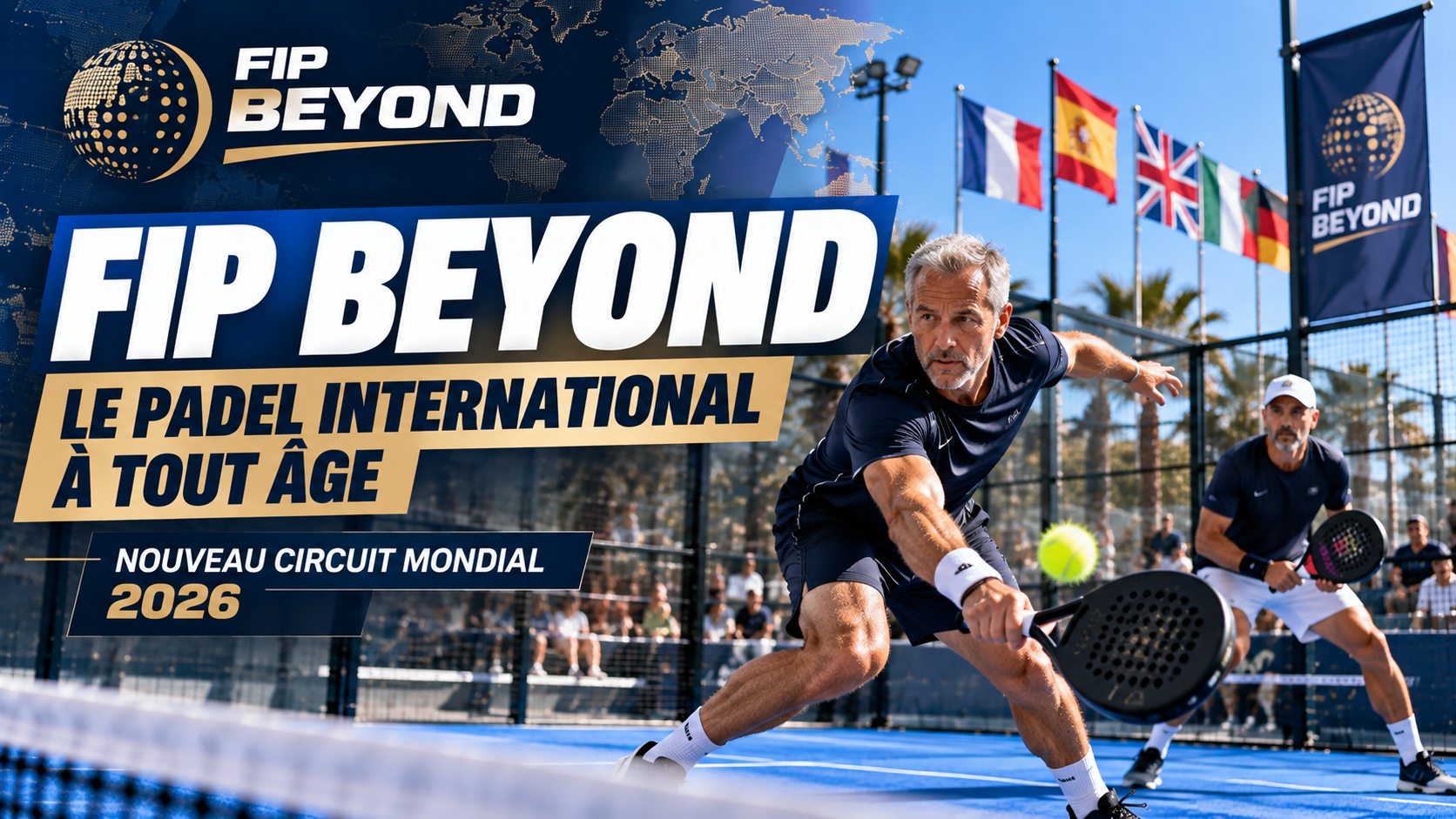 FIP Beyond: the new global padel circuit for amateurs and seniors
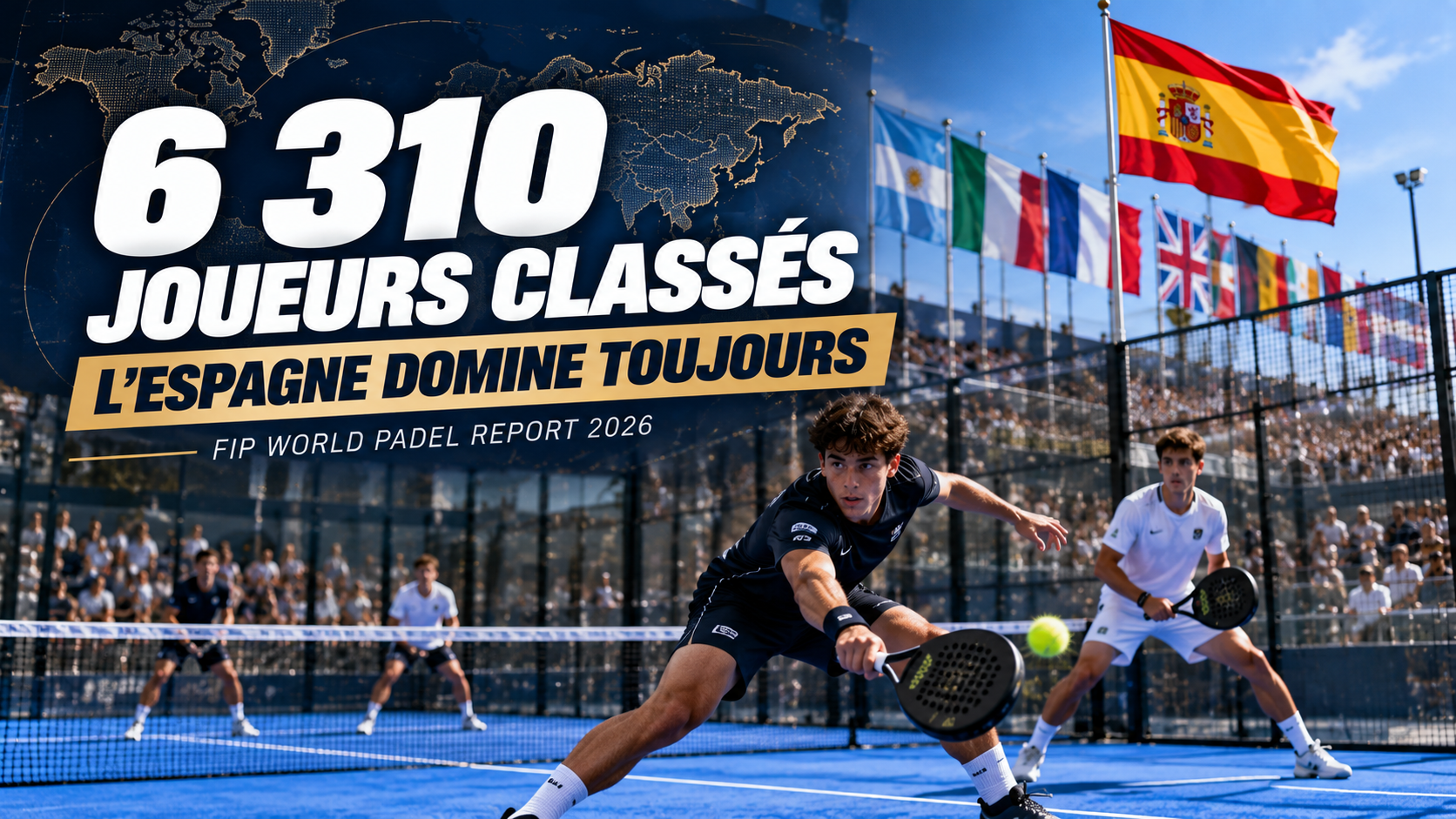 More than 6,300 FIP-ranked players: professional padel is becoming international, but Spain dominates
 OSS Barcelona – Why Spain and France aren't yet playing in the same league
 Cancer and rehabilitation: could padel become a therapeutic tool?
 Padel injuries: ankle, knee, elbow, eye… what the latest figures reveal
 Shocking turn of events at Dubai P1: Coello and Tapia have also withdrawn!
 Padel serve: a good serve is especially good preparation for the third shot.
 What the analysis of the stroke reveals: tennis forehand vs. padel bandeja
 Has the bandeja disappeared from modern padel?
 Flat forehand in padel: 5 exercises from Cristian Álvarez to gain control and efficiency
 Why can Libaak/Alfonso beat almost everyone… except Coello/Tapia?
 Tapia reveals his recipe for beating Coello / Tapia: "I would bet everything on myself"
 How Coello defused Chingotto's game plan
 In padel, does the chemistry between a pair count as much as individual skill?
 Organising a national padel competition: what are the FFT's requirements for clubs?
 Organising a P2000 or a P3000: how much does it really cost clubs?
 P2000 or P3000: what are the differences in prize money, format and organization in 2028?
 Do you lose your ranking? Padel FFT after more than a year without a license / without competition?
 Memory, reflexes, concentration: what happens in our brain when we play padel?
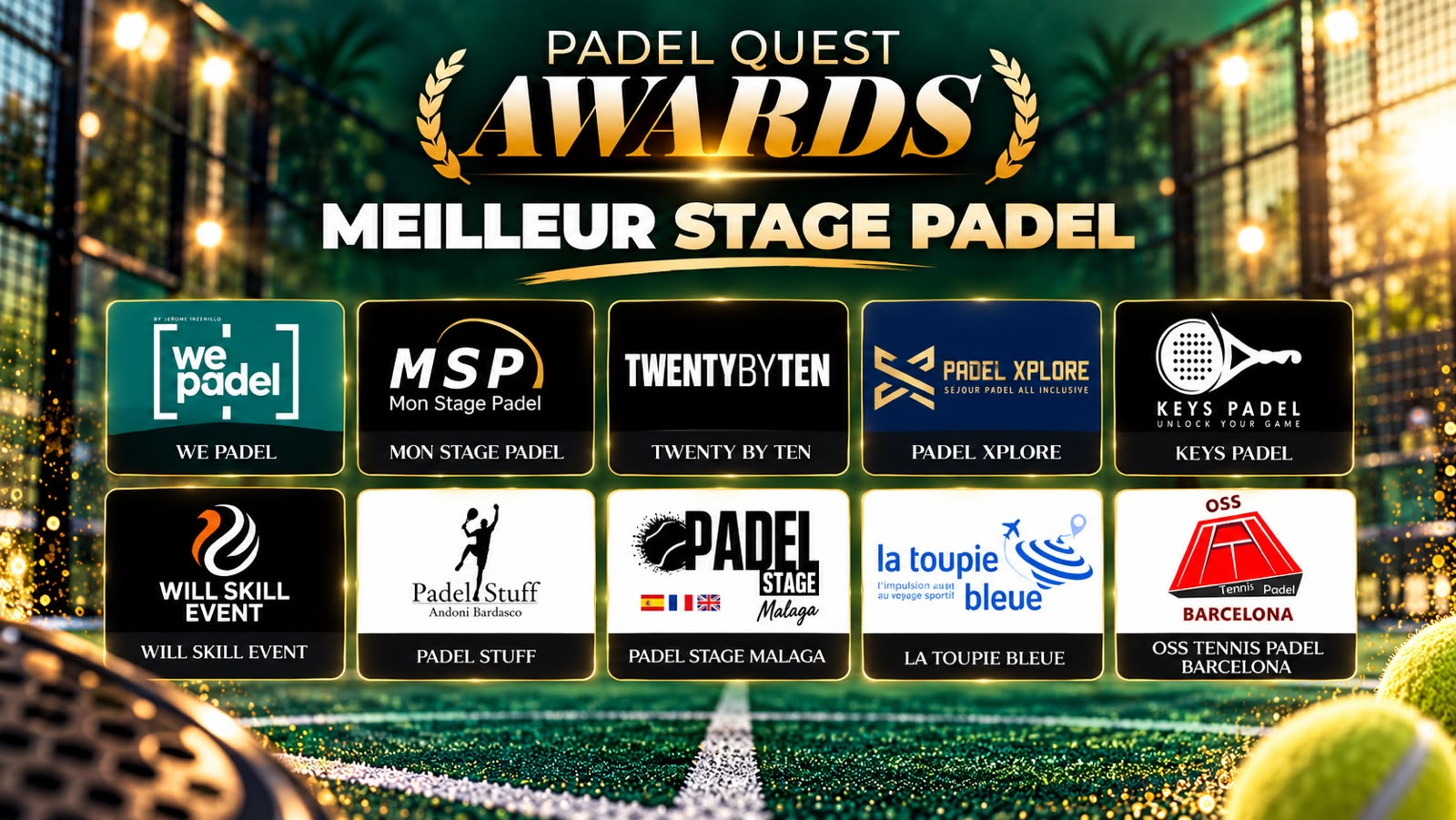 Padel Quest Awards: Ten specialists in the running for the title of best padel training camp of the year
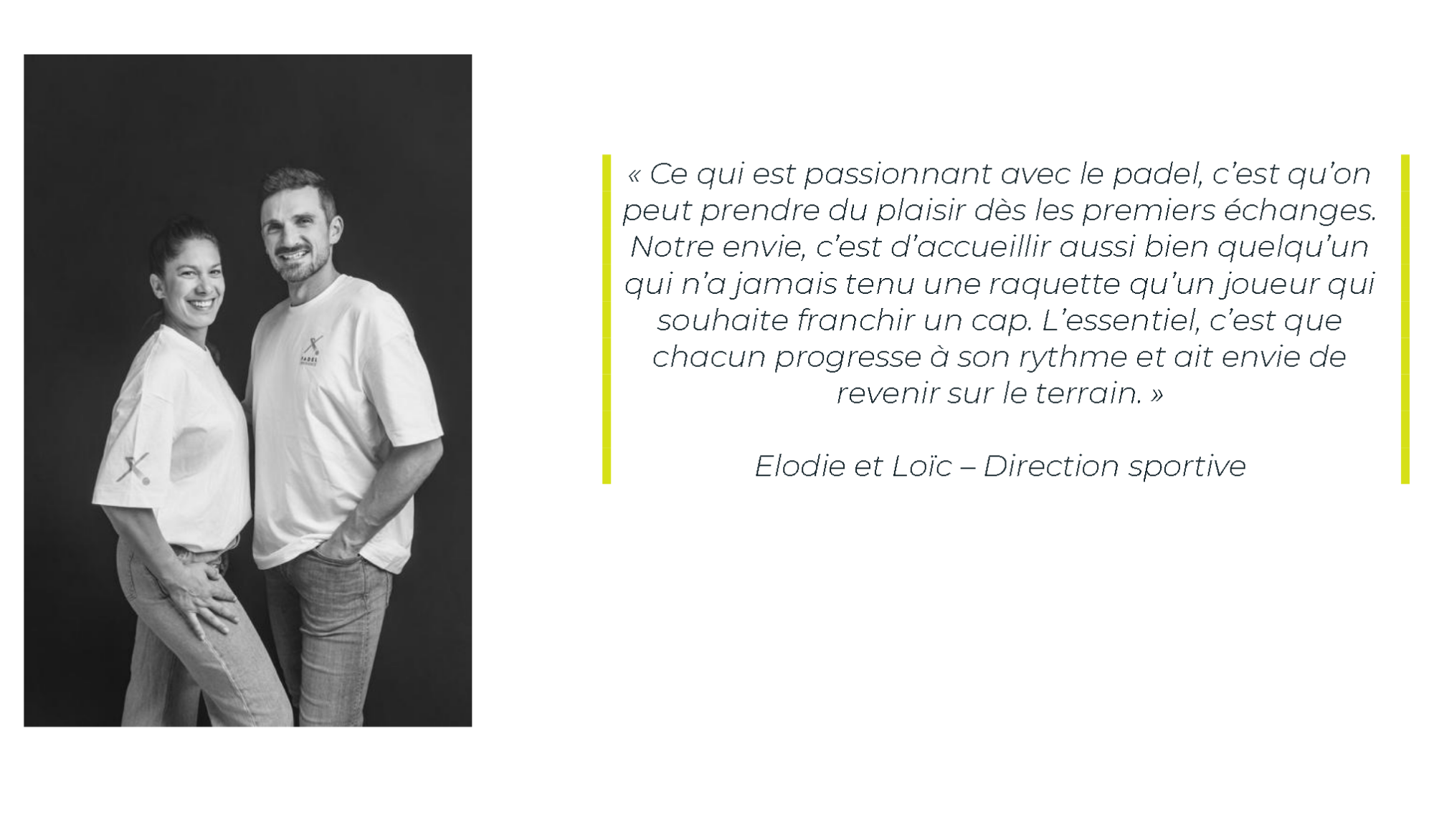 Padel Xperience: The Academy opens on November 2nd in Marcheprime, ahead of the complex's inauguration in 2027
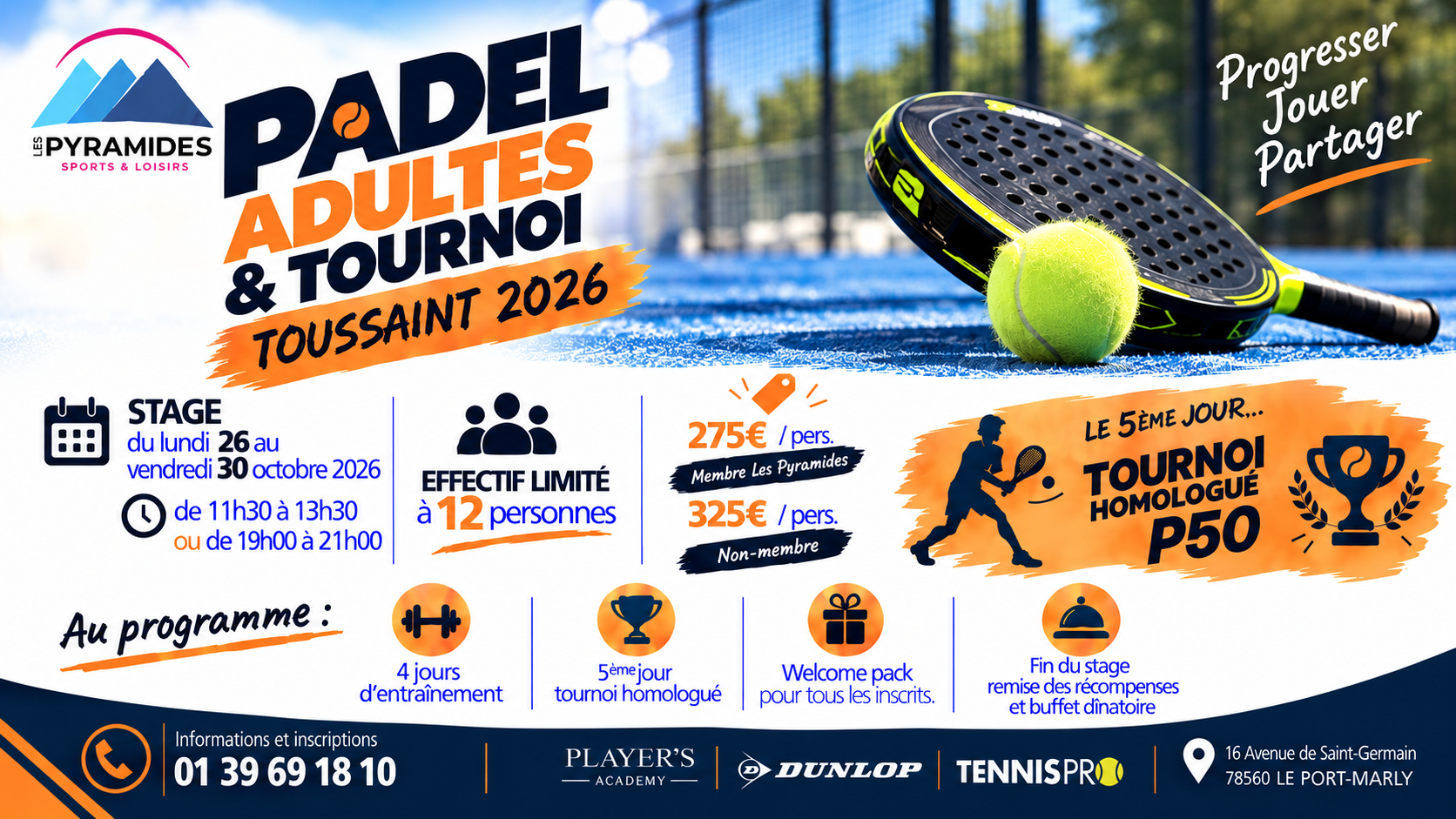 All Saints' Day – Les Pyramides are organizing a padel training camp for adults with a P50 tournament to close out the week