









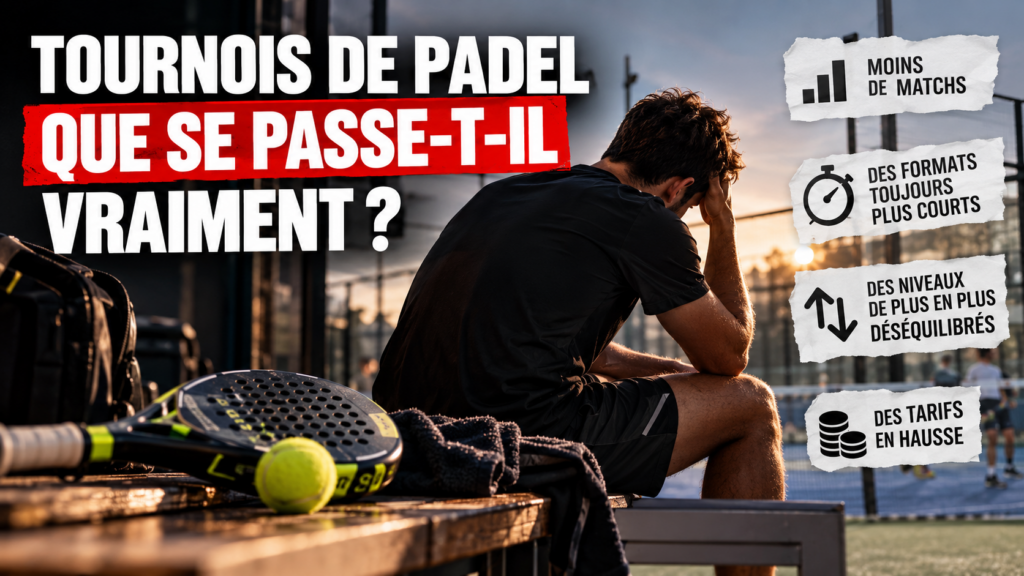
French padel has never had so many players, competitors, and sanctioned tournaments. Yet, behind this spectacular growth, a sense of unease is beginning to emerge on the amateur circuit. Sometimes difficult to fill schedules, shorter matches, significant level differences, rising prices: is amateur competition losing what made it successful?
The paradox deserves closer examination. While padel continues to develop at an impressive rate, some players feel they are playing less than before, facing opponents less close to their level, and paying more for a sporting experience that is sometimes less satisfying.
What if the problem stemmed precisely from this proliferation of tournaments?
An explosion in tournaments that is starting to raise questions
The figures from the French Tennis Federation are staggering. In 2018, France hosted 274 padel tournaments. By 2025, this number had reached 33,310. For the 2026 season, the FFT anticipates nearly 45,000 approvals , an accreditation that can cover up to three tournaments.
At the same time, the number of competitors has increased considerably. The FFT records 173,000 players participated in at least one tournament during the 2026 season. , including 151,000 men and 22,000 women.
These figures demonstrate the success of the development of padel in France. But they also raise a question: Is the supply of competitions still adapted to the actual demand, particularly at the local level?
Because multiplying the number of tournaments does not automatically mean multiplying the number of players available for each of them.
In some leagues, competitors now have several similar events, sometimes organized on the same day, a few kilometers apart.
As a result, entries can be spread across several clubs. Where a tournament once brought together a large field, several competitions can now share the same players.
Some organizers then find themselves with reduced schedules, or even difficulties in reaching the expected number of pairs.
The problem is therefore not necessarily a lack of players, but their distribution across an ever-increasing number of competitions.
First observation: players who are playing fewer matches
There was a time when participating in a padel tournament was almost a guarantee of spending several hours on the courts.
For around twenty euros, it was not uncommon to play four, five, or even six matches during a competition, depending on the packages offered.
Today, this practice seems to be becoming less systematic.
In some tournaments, participants only play two or three matches. The draws are sometimes smaller, the formats more streamlined, and there are fewer ranking matches.
This development does not only concern the P500 category. It can also affect the lower categories, where the pleasure of playing several matches was one of the main motivations of the participants.
Obviously, not all clubs operate this way. Some continue to offer competitions that are particularly generous in terms of playing time.
But a question arises: Should an amateur tournament primarily be about awarding points or should it offer a genuine sporting experience?
For many players, the goal is not just to improve their ranking. It's also about meeting different pairs, experiencing different playing styles, and simply playing padel.
Second observation: short formats are taking up more and more space
Another regularly observed development is the use of shortened game formats.
The format including Two sets of four games, with a deciding point at 40-all and a super tie-break to ten points in case of a one-set tie-break. , perfectly meets the organizers' requirements.
It allows for a series of matches, better control of schedules and the hosting of more matches on a limited number of tracks.
In certain configurations, matches can therefore be scheduled in slots of approximately 30 minutes, even if their actual duration remains variable.
From an organizational point of view, the benefit is obvious.
But from the players' perspective, the record is more debatable.
A match can end very quickly. A pair that gets off to a bad start has less time to recover. Opportunities for tactical adjustments are reduced, and the result may depend more on a few decisive points.
The short format is not bad in itself. It becomes problematic when it is accompanied by a decrease in the number of matches and an increase in the registration fee.
A player who plays three 30-minute games will ultimately have spent only an hour and a half in competition.
For a tournament to which he devoted half a day, or even more with travel, the ratio between the time invested and the time actually spent on the track can become frustrating.
Third observation: is the P500 losing its identity?
This is probably one of the most interesting phenomena to observe.
Historically, the The P500 represented an important step in a competitor's progression. It allowed already experienced players to face tough opponents in generally challenging brackets.
However, for over a year now, one impression has been recurring regularly: The level of the charts in some P500 tournaments seems to have dropped significantly, while the gaps between the best and worst pairs have widened.
It is no longer exceptional to find in the same competition experienced players, capable of producing structured padel, and others who are still discovering the fundamentals of competition.
The phenomenon can also appear in some P1000s, which are nevertheless associated with a higher level of competition.
However, be careful not to confuse two things.
It's not necessarily the overall level of French padel that's declining. It's the consistency of the draws that seems to be deteriorating in certain competitions.
The increasing number of tournaments is one possible explanation.
When several P500 tournaments are held in the same geographical area, the best pairs can be spread across different events. Some draws then become less competitive, which opens up more opportunities for less experienced players.
The P500 thus becomes a particularly exposed category: attractive enough to interest ambitious players, but sometimes less competitive than before.
This development is not unusual in itself. Players have every right to try their luck in a higher category when the rules allow it.
But it raises questions about the clarity of the sporting hierarchy.
What does the level of a P500 tournament still mean if two tournaments in this category can offer radically different matchups?
That's the paradox: more competitions can lead to less full and less homogeneous draws.
Fourth observation: tournaments are more expensive for less playing time.
This is perhaps the most sensitive point for the players.
For a long time, the padel tournament was considered excellent value for money.
For about 20 euros per person, it was possible to play several matches, sometimes four or more, and enjoy a real day of competition.
Today, some P500s display inscriptions reaching 30 euros per player, or 60 euros for a pair .
This increase could be understood if it were accompanied by an improvement in the experience offered.
But when the player plays fewer matches, in shorter formats, the perception changes radically.
Let's take two illustrative situations:
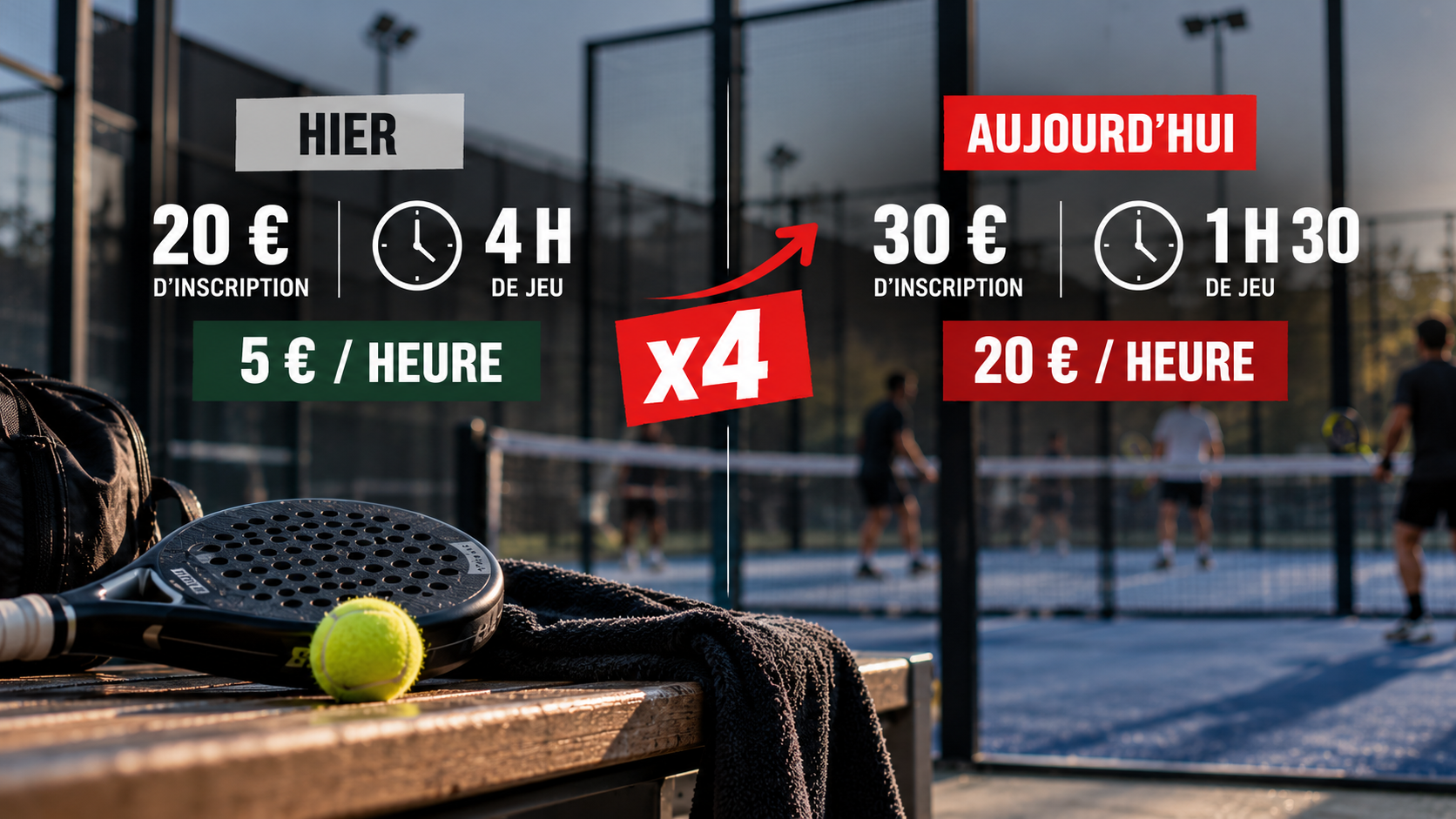
- Yesterday: 20 euros for four matches of approximately 60 minutes each, i.e. four hours of play and a cost of 5 euros per hour.
- Today : 30 euros for three matches of approximately 30 minutes each, i.e. an hour and a half of play and a cost of 20 euros per hour.
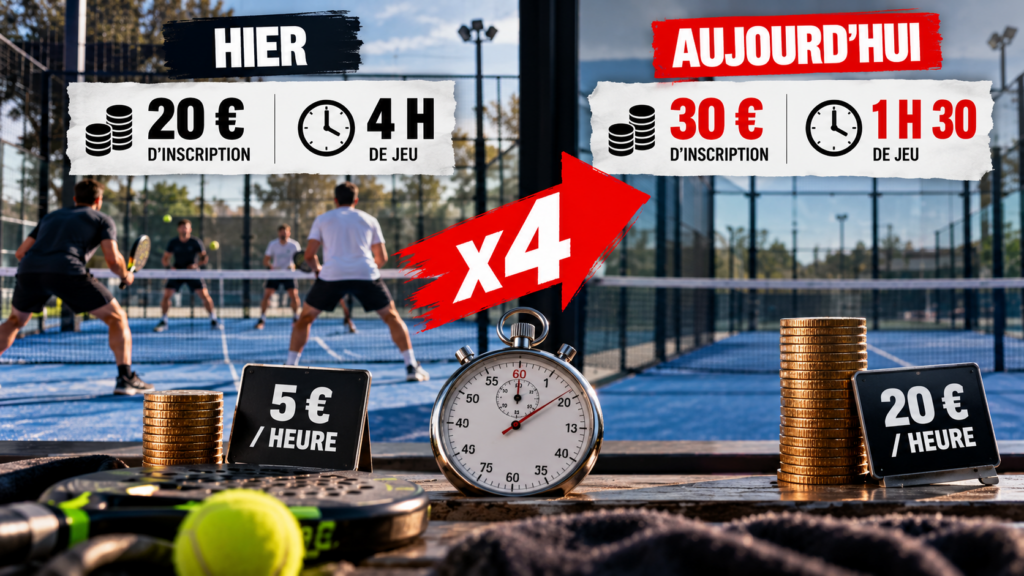
In this example, the hourly cost of the competition is multiplied by four .
Of course, this is not a national average. Formats, prices and durations vary considerably from club to club.
But this calculation perfectly illustrates the problem felt by some competitors.
The registration fee is no longer the only relevant indicator. We should also consider the number of guaranteed matches, their duration, and the actual playing time offered.
We must also take into account the economic constraints of the clubs: cost of facilities, staff, referee, availability of tracks and operating costs.
The organizers cannot necessarily offer more matches without increasing their costs.
But that doesn't change the central question: Does the player always get their money's worth?

Franck Binisti discovered padel at the Club des Pyramides in 2009 in the Paris region. Since then, padel has been part of his life. You often see him touring France to cover major French padel events.




































































 FIP rankings – Guichard drops, Fonteny moves closer to the top 100, Robert makes a great move
 Lebrón / Augsburger: Brussels had sent a message, Dubai reinforces the threat
 Dubai P1 – Fernández / Calvo: “Any of the three best pairs could be world number 1”
 4PADEL is recruiting a padel coach in Reunion Island: permanent contract or freelance
 Two and a half years to create a padel racket: HEAD reveals the manufacturing secrets of its 2027 models
 Javier Rodríguez Piris: “I would like Spain to host the World Championships in 2030”
 "We're not a tournament club": the gamble taken by the two Henry sisters who are hosting a P3000 at The Break Padel Club
 “Victim of Padel ": The Adventure Padel Jack Troster and Jack Troster are back with a new track and a crazy music video.
 Bullpadel 2027 in the feminine: the queens take to the track
 Blanqué and Joris remain untouchable, securing the title at the P3000 Break Padel Club
 Three consecutive serves in the Dubai final: the recurring umpiring error Premier Padel
 Padel, weight training, and even HYROX: clubs are changing their model
 Padel court rentals: a global market estimated at 4,6 billion euros
 FIP Beyond: the new global padel circuit for amateurs and seniors
 More than 6,300 FIP-ranked players: professional padel is becoming international, but Spain dominates
 OSS Barcelona – Why Spain and France aren't yet playing in the same league
 Cancer and rehabilitation: could padel become a therapeutic tool?
 Padel injuries: ankle, knee, elbow, eye… what the latest figures reveal
 Shocking turn of events at Dubai P1: Coello and Tapia have also withdrawn!
 Padel serve: a good serve is especially good preparation for the third shot.
 What the analysis of the stroke reveals: tennis forehand vs. padel bandeja
 Has the bandeja disappeared from modern padel?
 Flat forehand in padel: 5 exercises from Cristian Álvarez to gain control and efficiency
 Why can Libaak/Alfonso beat almost everyone… except Coello/Tapia?
 Tapia reveals his recipe for beating Coello / Tapia: "I would bet everything on myself"
 How Coello defused Chingotto's game plan
 In padel, does the chemistry between a pair count as much as individual skill?
 Organising a national padel competition: what are the FFT's requirements for clubs?
 Organising a P2000 or a P3000: how much does it really cost clubs?
 P2000 or P3000: what are the differences in prize money, format and organization in 2028?
 Do you lose your ranking? Padel FFT after more than a year without a license / without competition?
 Memory, reflexes, concentration: what happens in our brain when we play padel?
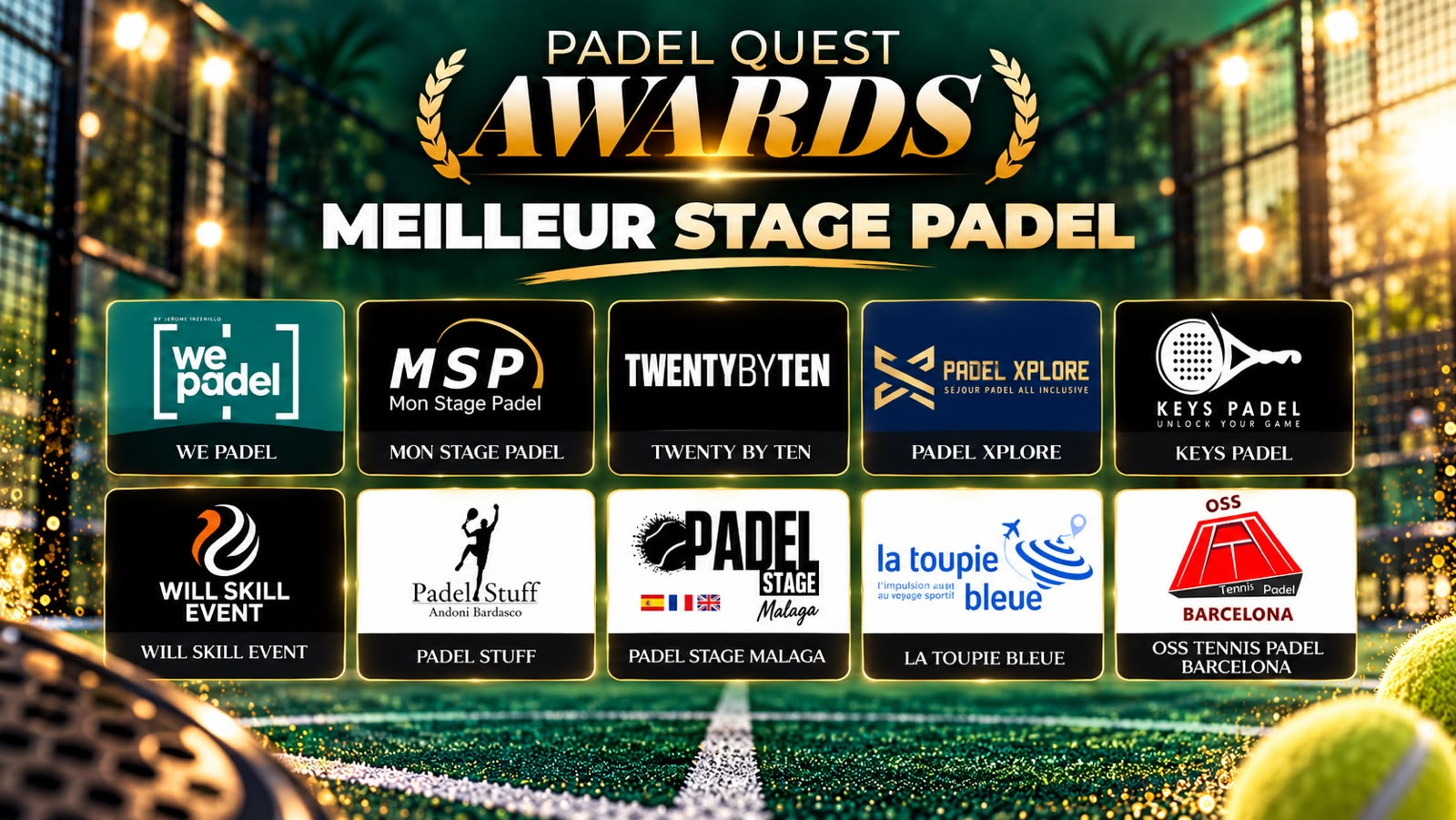 Padel Quest Awards: Ten specialists in the running for the title of best padel training camp of the year
 Padel Xperience: The Academy opens on November 2nd in Marcheprime, ahead of the complex's inauguration in 2027
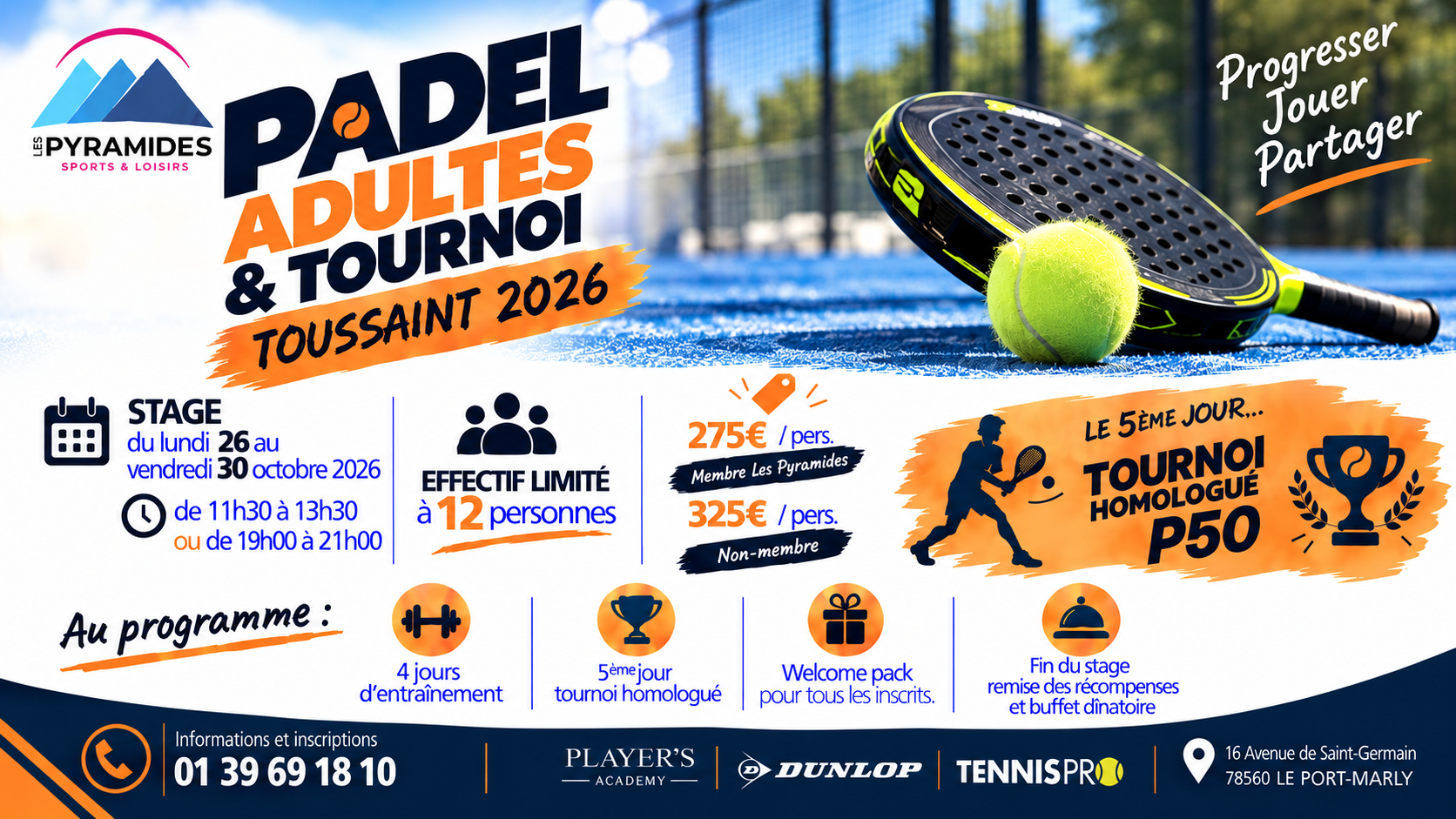 All Saints' Day – Les Pyramides are organizing a padel training camp for adults with a P50 tournament to close out the week