

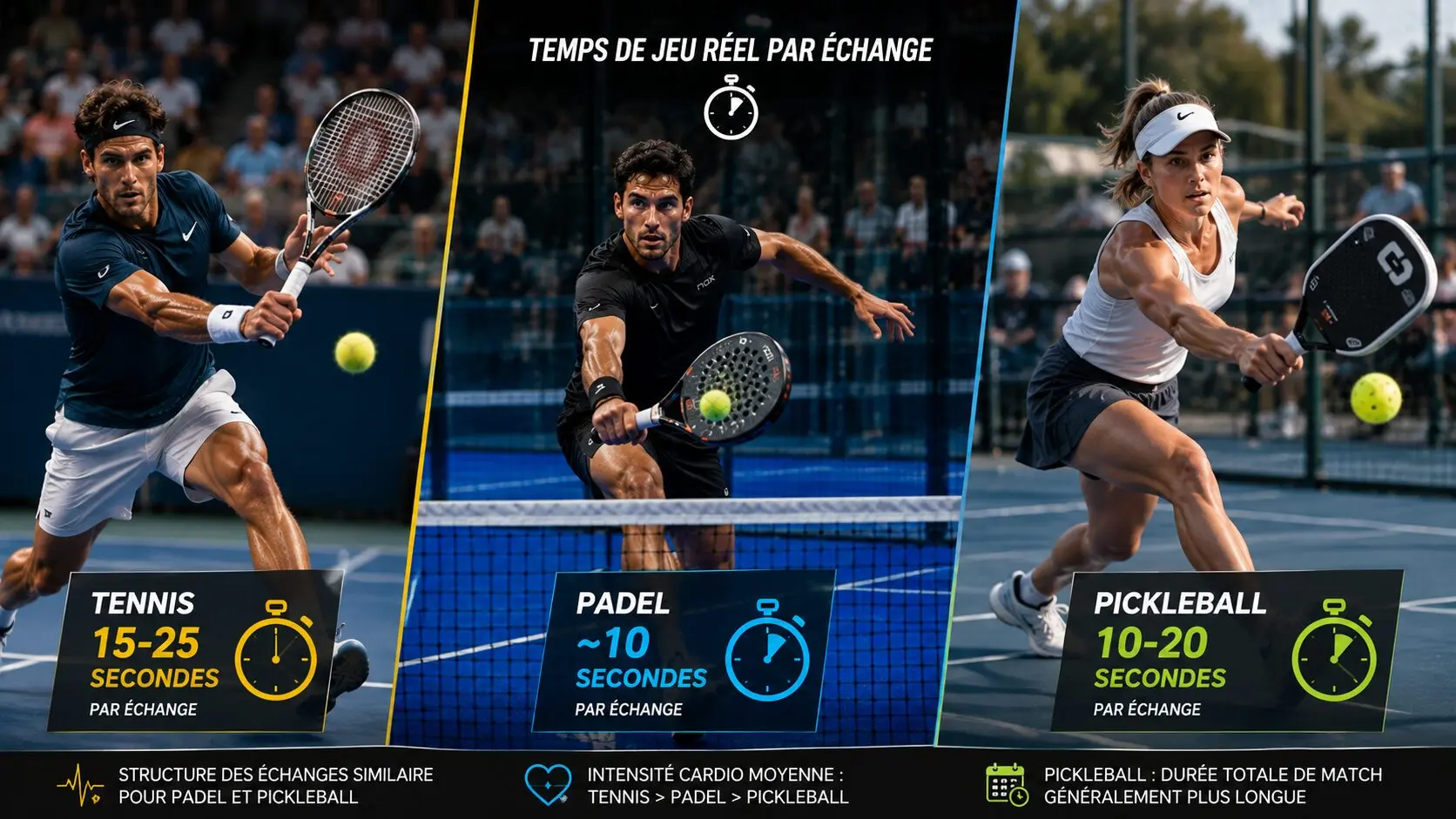







In pickleball, each rally lasts on average 10 to 20 seconds for about 11 ball strokes — a format very close to that of padel — but the available heart rate data shows that this sport remains overall a notch below tennis in intensity, while offering a cardiovascular stimulus that is quite sufficient for a health objective.
Pickleball has become one of the most popular sports in the United States in just a few years—driven by impressive year-over-year growth in participation, according to American sports federations. It is played on a small court, with rigid paddles and a perforated plastic ball, somewhat like a cross between tennis, badminton, and table tennis. But despite this meteoric rise, scientific research on its physiological demands remains, for the time being, significantly less extensive than that available on tennis or even padel.
That said, several recent studies are beginning to fill this gap, and already allow us to answer with a reasonable level of rigor a simple question: in an hour of pickleball, how much time is actually played — and how does this figure compare to tennis and padel, already analyzed in our previous articles?
1. Actual playing time in pickleball: short but frequent rallies
The average duration of an exchange
A recent study (2026) of professional men's singles pickleball matches measured the exact structure of the exchanges: Most points last between 3 and 5 ball strikes (53,1% of trades), with an average trade duration between 10 and 20 seconds On the professional doubles circuit, an analysis of tournament finals measured an average of 10,8 hits per exchange — a figure which, moreover, tends to decrease year after year, a sign that the game is becoming faster and more explosive as the level of players progresses.
This structure brings pickleball much closer to padel than to tennis: in padel, as a reminder (see our article on effective playing time), a point lasts on average 10 seconds Pickleball, therefore, falls within a very comparable range, or even slightly higher in some exchanges.
A permanent "stop-start" game
Pickleball physical conditioning specialists describe the sport as a succession of short bursts of effort followed by rapid recovery periods — a training format that, structurally, resembles what is observed in padel. In terms of energy, pickleball is described as a “hybrid” sport by physical trainers: each rally uses anaerobic pathways in the very short term (ATP-PC and glycolytic pathway, mobilized for explosive efforts of a few seconds), while the ability to sustain these efforts over the total duration of a match — which can exceed one hour in a tournament — relies on a good base aerobic capacity.
2. What heart rate and VO2 data show
Moderate to sustained intensity, but generally lower than tennis
Available studies report a fairly variable average heart rate depending on the level of play:
- Recreational players : in between 108 and 134 beats per minute according to a study conducted by an American university (East Carolina University, 2023), this places pickleball in the moderate intensity zone (64-76% of the theoretical maximum heart rate).
- Advanced/Veteran Players : a higher average heart rate, around 148 to 150 beats per minute , with oxygen consumption (VO2) measured at approximately 23-25 ml/kg/min during play — a level of effort that remains in a sustained rather than extreme aerobic zone.
A particularly interesting direct comparison comes from a large field study based on smartwatch data (the Apple Heart and Movement Study), which analyzed nearly 98,000 workout sessions recorded by more than 5,600 users playing tennis and pickleball. The result: Tennis sessions spend on average 9% more time in moderate to intense heart rate zones. compared to pickleball sessions. On the other hand, pickleball sessions last longer on average (approximately 90 minutes compared to 81 minutes for tennis) — which qualifies the difference in intensity by a slightly longer total duration.
An important nuance regarding the quality of the available data
We need to be transparent about one point: unlike tennis or padel, a significant portion of the available data on pickleball still comes from on-court measurements via smartwatches or player feedback, rather than from laboratory studies as rigorous as those that have long existed for tennis. This isn't a weakness specific to pickleball, but simply a reflection of the fact that it's a sport that's still young in terms of scientific research—studies are evolving rapidly, but the body of data remains smaller than for more established sports.
3. Calorie expenditure: moderate sport, but highly variable depending on the format
As is often the case with sports energy expenditure, the figures vary considerably depending on the studies and the level of play:
| Format | Estimated calorie expenditure |
|---|---|
| recreational pickleball | 300 to 400 kcal/hour on average (one study suggests approximately 350 kcal/h) |
| Competitive Pickleball in Singles | Up to 450-560 kcal/hour according to sources |
| Doubles pickleball (recreational or tournament) | Generally less expensive than a single entry, due to the division of the land between two people. |
| Singles tennis (for comparison) | 420 to 560 kcal/hour depending on the intensity |
The trend emerging from all available data is consistent: competitive singles pickleball is approaching tennis in caloric intensity, while recreational doubles pickleball — the format most practiced by beginners and casual players — remains in a more moderate zone, which largely explains its reputation as an “accessible” sport, particularly among seniors.
4. Direct comparison: pickleball, tennis, padel
| Criterion | Pickleball | Tennis (singles) | Padel |
|---|---|---|---|
| Average duration of an exchange | 10-20 seconds (≈ 11 strikes) | Variable (2-10 seconds depending on the surface) | ≈ 10 seconds |
| Actual playtime over 1 hour | Data still limited, but structure similar to padel | 10-18 minutes | 27-30 minutes |
| Average FC (recreational players) | 108-134bpm | 140-180bpm | 140-150bpm |
| Average FC (advanced players) | 148-150bpm | Likewise, more frequent peaks | Peaks at 177-188 bpm |
| Calorie expenditure/hour | 300-450 kcal (up to 560 in competition) | 500-800 calories | 400-600 calories |
| Land size | Small (similar to badminton) | scale | Intermediate, enclosed by windows |
| Dominant energy sector | Hybrid: anaerobic during exchange, aerobic over time | Mixed, varying according to the surface area | Aerobic with anaerobic peaks |
5. Key takeaways from this comparison
Regarding the structure of the game (duration of exchanges, alternation of effort/recovery), Pickleball is much closer to padel than to tennis. Short points, an average of about ten shots, a fast pace. But in terms of measured cardiovascular intensity, the currently available data places recreational pickleball slightly below tennis and generally in a range close to padel , however, with significant variability depending on the level of play — competitive singles pickleball can, in some respects, rival tennis in intensity.
This combination — a structurally dense game but an overall moderate cardiac intensity — largely explains pickleball's success with a wide audience, including seniors and beginners in racket sports: the format is engaging and dynamic, without requiring the level of cardiovascular endurance of singles tennis or squash.
Pickleball shares with padel a game structure characterized by short, close rallies (10 to 20 seconds per point, around ten shots on average), making it, in this specific respect, closer to padel than to tennis. However, in terms of cardiovascular intensity measured by heart rate, current data—still being compiled for this relatively new sport—suggests an intensity generally slightly lower than that of tennis, with significant variability depending on the level of play and the format (singles or doubles). Pickleball thus stands out as an excellent compromise between the intensity of the game and its physical accessibility, which explains a large part of its meteoric rise in popularity worldwide.
F.A.Q
Is pickleball as physically demanding a sport as tennis? Current data suggests an overall intensity slightly lower than that of singles tennis, with a more moderate average heart rate among recreational players. However, competitive singles pickleball can approach tennis in intensity according to certain measures.
Why is pickleball so similar to padel in terms of game structure? Because both sports are played on a smaller court than tennis, with shorter and closer exchanges (around 10 seconds on average for padel, 10 to 20 seconds for pickleball), unlike tennis where the time between points is generally longer.
Is pickleball suitable for beginners and seniors? Yes: the combination of a smaller playing area, lower joint impact than tennis and moderate to sustained cardiac intensity (often in the zone recommended for cardiovascular health) makes it a particularly accessible sport for resuming physical activity.
Why is there less scientific data on pickleball than on tennis? Simply because pickleball, although invented in the 1960s, only experienced its massive growth very recently. Scientific research generally takes several years to produce a body of studies as robust as that which exists on sports played for decades, such as tennis.
Sources and methodology
- Lozano, M., Casals, M., Ampuero, R., Campos-Rius, J., De Pablo, B., Baiget, E. (2026). Match activity profile analysis during professional single male pickleball matches.
- Derrickson, C. (JOOLA). Understanding Pickleball Physical Demands — data on the length of rallies in professional singles and doubles (US Open 2019, Georgia 2022).
- Smith, LE, Buchanan, CA, Dalleck, L. (2018). The acute and chronic physiological responses to pickleball in middle-aged and older adults. International Journal of Research in Exercise Physiology.
- Apple Heart and Movement Study (Brigham and Women's Hospital / Harvard) comparing heart rate zones between tennis and pickleball sessions, based on data from smartwatches (nearly 98,000 sessions analyzed).
- East Carolina University study (2023) on heart rate and caloric expenditure of recreational pickleball players.
- VO2 and heart rate data in veteran and recreational pickleball players (literature reviews in sports physiology).
- Sañudo, B. et al. (2008) and Ferrauti et al. (2003) for the reference data on padel and tennis (already cited in our article on the effective playing time of tennis vs padel).
This article was written using publicly available scientific and field sources as of August 2026. Pickleball is a sport for which scientific research is still under construction, so some data comes from field measurements (smartwatches, player feedback) rather than laboratory studies as controlled as those available for tennis — this distinction is specified whenever it applies.

Franck Binisti discovered padel at the Club des Pyramides in 2009 in the Paris region. Since then, padel has been part of his life. You often see him touring France to cover major French padel events.





















































 Padel Quest Awards: Which is the best padel app in France? Voting opens at 18 PM
 Paquito Navarro wants to leave at the top: "I'm giving myself until the end of 2028"
 At just 16 years old, Victoria Vílchez will play in the World Cup with Argentina: who is this young prodigy?
 France or Portugal, Spain or Argentina: Miguel Lamperti ranks the best padel nations
 Cédric Lavoye: "Hard work pays off" and a first FIP tournament in Guadeloupe is in his sights
 Nicolas Rouanet is preparing his return in 2027: “With Bastien Blanqué, I would never say no”
 Leygue/Blanqué respond bluntly to the criticism: "You can say what you want... We're putting all our money and our lives into this."
 Doinsport and PISTA join forces: padel is finally coming alive!
 P1000 4Padel Limoges: Sarrat/Fabre favorites, Bernard/Peloux and Henrion/Mitjana ready to play spoiler
 P1000 Drag'N Ball Draguignan: Biron / Tullou and Gourre / Vial, a duel for the title?
 Milan P1 – The journey ends for Alix Collombon and Léa Godallier, defeated in two sets in the first round
 Düsseldorf P2: Sanz runs more than anyone else, Fernández and Calvo dominate the numbers… what the finals statistics reveal
 Milan P1 – Can Guichard and Geens repeat Leygue and Moya's feat against Goñi / Alonso?
 Leo Augsburger launches his own brand: a burger as the logo for the new Argentinian star
 Milan P1 – Guichard/Geens face a tough challenge, the favorites take to the court: Wednesday's schedule
 For sale: two padel clubs in Mauritius, starting from 330,000 euros
 How much does it actually cost to organize a FIP Bronze event?
 Padel How Lidl is transforming Crivit into a fully-fledged sports brand with Steffi Graf
 Compagnie des Alpes is accelerating its involvement in padel with PadelCity: a new step in its European strategy
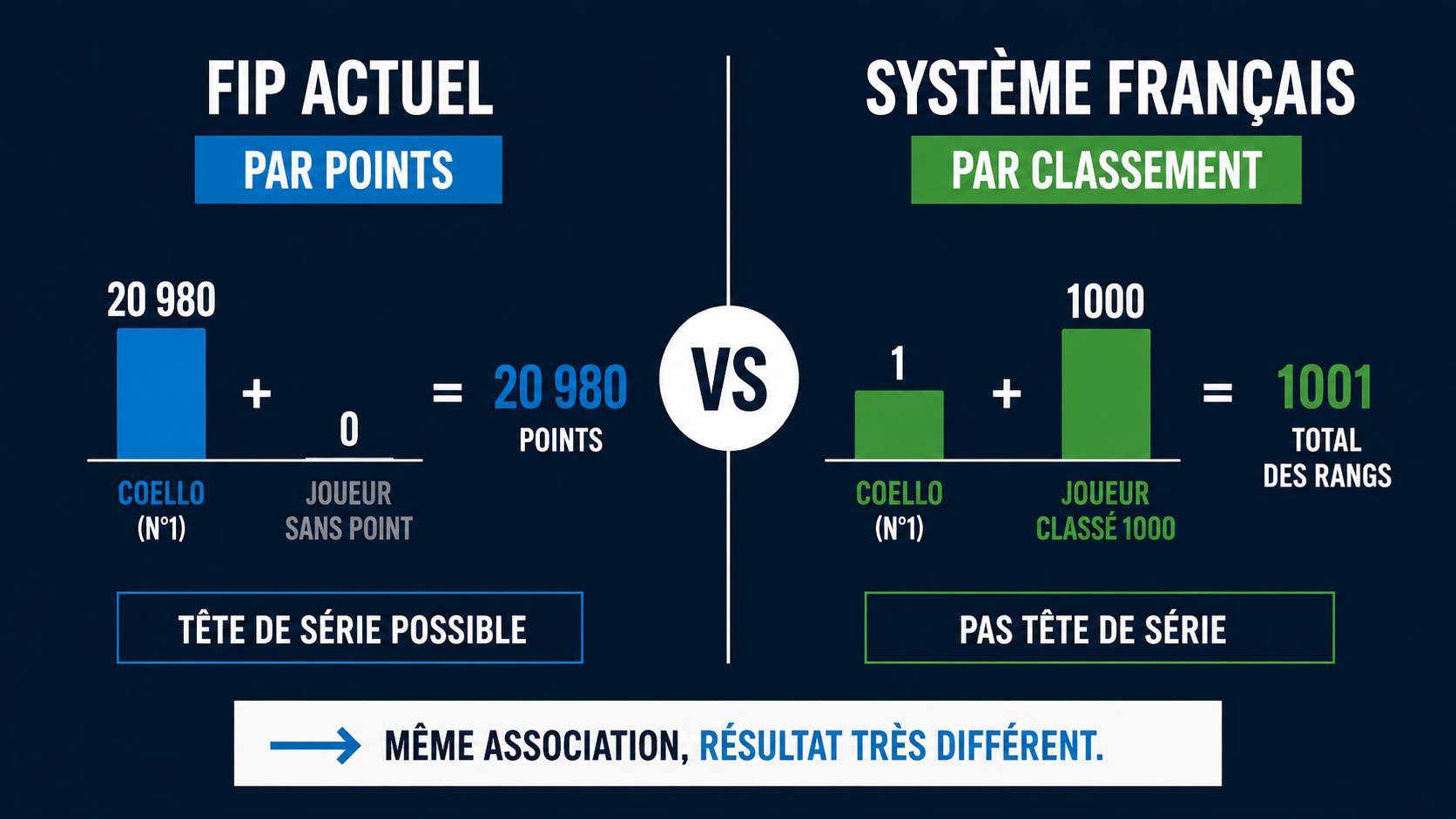 Coello with a player at 0 points ahead of two top 10 players: should the FIP ranking be reviewed?
 Les Pyramides: after 12 padel courts, the club is focusing on youth training
 Health Care Padel Tour 2026: What if your next padel tournament was played in Barcelona?
 FAST Padel Academy continues its development and establishes itself in Liège.
 What the analysis of the stroke reveals: tennis forehand vs. padel bandeja
 Has the bandeja disappeared from modern padel?
 Flat forehand in padel: 5 exercises from Cristian Álvarez to gain control and efficiency
 Why knowing how to play on the right and left can make all the difference
 Tapia reveals his recipe for beating Coello / Tapia: "I would bet everything on myself"
 How Coello defused Chingotto's game plan
 In padel, does the chemistry between a pair count as much as individual skill?
 Summer changes padel… but what if the real challenge wasn't hitting harder?
 Neither FIP Tour nor World Team Championship: the unique format of padel at the Mediterranean Games
 Premier Padel : when television can lengthen players' breaks
 Premier Padel Yes, a referee can refuse a player permission to go to the toilet
 Julien Seurin opens up about his mental state: "There are far more doubts than moments of happiness."
 More than a year later, Thomas Leygue is back in the top 150: behind the scenes of a comeback that's still unfinished
 Padel vs squash vs badminton: the scientific ranking of cardio intensity
 Why does Arturo Coello play with his right hand bandaged?
 What if your progress in padel depended on what nobody else is looking at?