


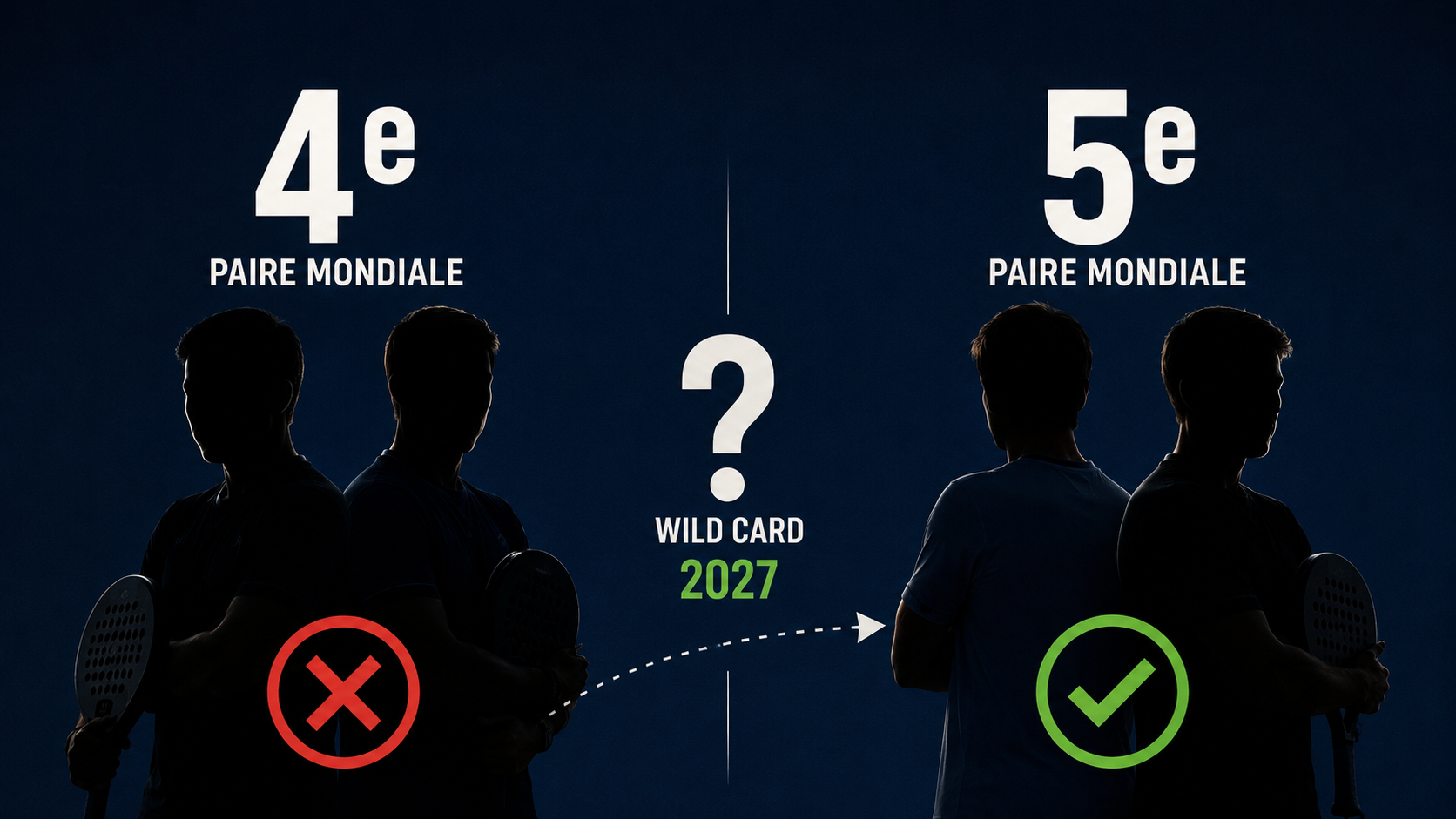







The FIP Gold tournament in Belgrade offers a textbook example. Coki Nieto/Mike Yanguas and Franco Stupaczuk/Jon Sanz, ranked 4th and 5th in the world respectively at the time of registration, are separated by only 21 points. In 2026, both teams can freely claim the 150 points awarded to the winners. In 2027, it won't be so simple: for players individually ranked between 5th and 16th in the world, participating in a FIP Gold tournament will require a wild card. This measure, intended to protect the CUPRA FIP Tour, nevertheless raises a crucial question: what will happen if, between two pairs directly competing in the rankings, one receives an invitation and the other doesn't?
Belgrade: 21 points separate the 4th and 5th ranked pairs in the world
Le FIP Gold of Belgrade , scheduled from August 24 to 30, is much more interesting than a simple Gold.
Two pairs, ranked just behind the very best associations in the world, have decided to make the trip to Serbia:
Coki Nieto / Mike Yanguas , ranked 4th in the world at the time of registration, with 11,697 cumulative points;
Franco Stupaczuk / Jon Sanz , 5th in the world, with 11,676 points.
They are separated by only 21 points.
At this level, every tournament counts. Especially since a place gained or lost in the rankings can then have consequences for seeding and therefore for the draws. Premier Padel.
The calculation is therefore quite easy to understand: a FIP Gold unit yields 150 points per player .
When only 21 points separate two pairs, Belgrade becomes a true extension of their battle on Premier Padel.
But this situation will become much more complex in 2027.
The individual top 4 is prohibited: a rule that should not drastically alter the current situation.
The FIP and Premier Padel announced in June the new restrictions that will come into effect in 2027 on the FIP Tour.
Regarding FIP Gold funds, two categories are created:
- ranked players Those ranked 1st to 4th in the world will be banned from participating ;
- ranked players players ranked 5th to 16th in the world will only be able to participate thanks to a wild card. .
Note an important distinction: the FIP is referring here to the individual player rankings , and not the ranking of pairs.
In the current configuration of world padel, the first measure – the ban on the four best players – is not expected to cause a revolution.
The members of the "Big 4" are already essentially competing Premier Padel and do not need to gain 150 points on a Gold to protect their position.
Above all, the points gap that currently exists between the top four players in the world and their pursuers makes the danger relatively limited.
In other words, the FIP partially formalizes a situation that already exists naturally.
But this rule also rests on the current hierarchy
However, this is a snapshot of padel in 2026.
Let's imagine tomorrow that a third world pair actually manages to get involved in the battle with the two best pairs in the world.
Individual gaps could then narrow considerably.
In this configuration, the boundary between world No. 4 and No. 5 would become much more problematic.
The fourth one would be completely banned from FIP Gold.
The fifth player could still participate with a wild card.
If only a few dozen or hundred points separate them, one could therefore have an additional opportunity to score points that his direct competitor would not have.
This scenario remains largely theoretical today, given the differences at the top.
But if the global hierarchy tightens in the future, the FIP will probably have to monitor the effects of this very clear boundary between fourth and fifth place.
The real problem could mainly concern players ranked from 5 to 16
In the short term, the new regulations raise the most questions elsewhere.
Because between the 5th and 16th place worldwide Players will not be banned from Gold.
They will be able to participate.
But only if they obtain a organizer's wild card .
And that difference changes a lot of things.
A wild card is not automatically granted based on ranking. It is awarded by the tournament organizers and then submitted to the FIP for approval.
The FIP regulations also specify that the organizers propose the wild cards they wish to award and that no compensation can be requested or offered in exchange for an invitation.
But from a sporting perspective, one question remains:
What happens when several players in the top 16 are directly competing for the same ranking positions and some receive a wild card while others do not?
The Belgrade case allows us to immediately understand the problem
Let's return to the specific situation in Belgrade.
Nieto/Yanguas and Stupaczuk/Sanz are separated by only 21 points in the battle between the 4th and 5th ranked pairs in the world.
In 2026, no problem: both pairs have the opportunity to participate in the Gold and therefore to go for the same 150 points.
Let us now apply the principle announced for 2027.
If their four players are still individually ranked between 5th and 16th place, they will have to go through a wild-card.
Let's imagine then that the organization invites Nieto / Yanguas but not Stupaczuk / Sanz.
Or the other way around.
The selected pair would have access to 150 potential points in a competition in which her direct competitor simply could not participate.
And when there are 21 points between two associations, 150 points obviously represents a considerable difference.
This is where a real one can appear distortion in the ranking race .
A wild card could indirectly influence the world hierarchy
The problem does not stem from the principle of the wild-card itself.
Invitations exist in virtually all racket sports and allow organizers to include local players, young players, former stars, or players of particular interest to the tournament.
But here, the wild-card would have an additional function.
For a player ranked between 5th and 16th in the world, it would no longer simply allow them to obtain a privileged place in a draw.
It would become the only possible entry point into the tournament.
The distinction is important.
The organizer could therefore indirectly allow a player to compete in a competition counting towards the world ranking while a direct competitor, although better or almost as well ranked, would not have access to the same points.
This obviously does not mean that the recipient will win the tournament.
But the two competitors would no longer have the same departure opportunities .
And the situation can become even more delicate with the ranking of pairs
Padel also has a unique feature: the ranking is individual, but the competition is played in pairs.
That is why it is necessary to constantly distinguish a player's world ranking et the global position of a pair .
The 2027 regulations are based on the first one.
But the sporting consequences are often felt on the second player.
A Nieto/Yanguas vs. Stupaczuk/Sanz match is not simply a battle between four individual rankings.
It is also, and above all, a battle between the 4th and 5th world pair , with the stakes of seeding behind it Premier Padel.
And that is precisely what makes the wild-card system particularly sensitive.
A decision made on access to a FIP Gold could then have consequences on the hierarchy of pairs and, indirectly, on the composition of the main circuit tables.
The FIP is nevertheless trying to solve a real problem
We must not lose sight of the reason for this reform.
The FIP Tour is intended, in particular, to allow lower-ranked players and emerging talents to progress and gradually reach Premier Padel.
However, the points offered in certain categories have gradually attracted extremely highly ranked players.
Paula Josemaría had perfectly summarized it in an interview given to SPORTS In June: winning a FIP Platinum currently pays out 300 points , against 180 points for a quarter-final in P1 .
She believed that the problem did not originate with the players.
The system itself encourages them to go and get those points.
The FIP has clearly heard this criticism, since its 2027 reform addresses both aspects: to revalue the first rounds of Premier Padel and limit access to the FIP Tour for top players.
The objective is consistent.
It is its application that could produce some side effects.
Why not define a purely sporting criterion?
This is probably the debate that the 2027 season will open up.
Between places 5 and 16, is it really necessary to make access to FIP Gold dependent on a wild-card?
Or should we imagine a system guaranteeing that two players – and especially two pairs – engaged in a direct battle in the ranking have the same opportunities?
Because the problem is not that a pair of the world's top players are competing in a Gold.
The problem would arise if one pair can compete and a direct competitor cannot, solely because an organizer chose to award their invitation to one rather than the other.
From then on, the wild-card no longer represents just a tool for organizing a tournament.
It could become a factor in the race for the world rankings.
Belgrade 2026, a textbook case before the reform
This is what makes the upcoming FIP Gold in Belgrade so interesting to watch.
Two world-ranked pairs separated by 21 points.
A tournament offering 150 points to the winner.
And both have the same opportunity to go and get them in 2026.
It is precisely this equality of access that may no longer be guaranteed in 2027.
The FIP reform addresses a real problem: preventing the CUPRA FIP Tour from becoming a points reserve for the best players. Premier Padel.
For the current individual top 4, the restriction should be almost painless as the gap with the pursuers remains significant and as these players already rarely frequent the Gold.
For players ranked between 5th and 16th place, however, the question is much more delicate.
Belgrade's FIP Gold almost provides us with a demonstration of this ahead of time.
If tomorrow two pairs separated by 21 points find themselves in this situation and only one receives a wild-card, can we really consider that their battle for the ranking is taking place on equal terms?
It is probably on this point, more than on the ban on the top 4, that the new 2027 regulations will need to be observed very closely.

Franck Binisti discovered padel at the Club des Pyramides in 2009 in the Paris region. Since then, padel has been part of his life. You often see him touring France to cover major French padel events.

















































































 Sanyo Gutiérrez questions the future of Galán and Chingotto: "I don't see them returning for another year."
 P1000 Arsenal Padel – Cazaban/Rubio are the clear favorites, but there is strong competition.
 Premier Padel Stupaczuk / Sanz: two consecutive finals, two victories against Galán / Chingotto… is a new hierarchy emerging?
 Padel is changing dimensions: the impressive figures of the 2026 global report
 France or Portugal, Spain or Argentina: Miguel Lamperti ranks the best padel nations
 Cédric Lavoye: "Hard work pays off" and a first FIP tournament in Guadeloupe is in his sights
 Nicolas Rouanet is preparing his return in 2027: “With Bastien Blanqué, I would never say no”
 Leygue/Blanqué respond bluntly to the criticism: "You can say what you want... We're putting all our money and our lives into this."
 Doinsport and PISTA join forces: padel is finally coming alive!
 P1000 4Padel Limoges: Sarrat/Fabre favorites, Bernard/Peloux and Henrion/Mitjana ready to play spoiler
 P1000 Drag'N Ball Draguignan: Biron / Tullou and Gourre / Vial, a duel for the title?
 Milan P1 – Lebrón/Augsburger face the Alonso/Goñi trap, the favorites for their first tests: Thursday's schedule
 Powerleague is changing its strategy: after the courts, it's now the coaches' turn to retain padel players.
 Guillaume Debelmas (4PADEL): "The padel market is developing faster than expected, but we must be careful about rents."
 For sale: two padel clubs in Mauritius, starting from 330,000 euros
 How much does it actually cost to organize a FIP Bronze event?
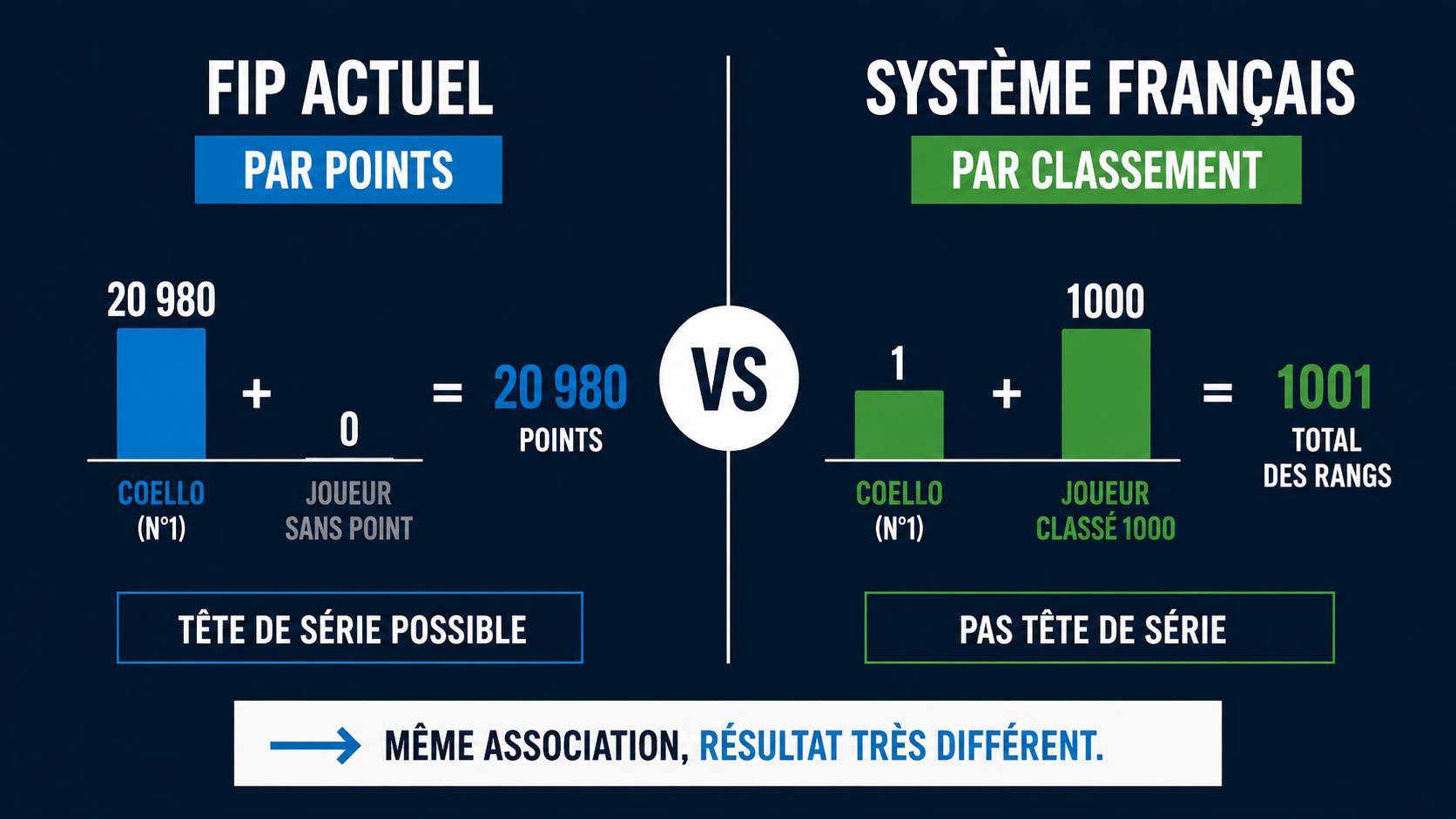 Coello with a player at 0 points ahead of two top 10 players: should the FIP ranking be reviewed?
 Les Pyramides: after 12 padel courts, the club is focusing on youth training
 Health Care Padel Tour 2026: What if your next padel tournament was played in Barcelona?
 FAST Padel Academy continues its development and establishes itself in Liège.
 What the analysis of the stroke reveals: tennis forehand vs. padel bandeja
 Has the bandeja disappeared from modern padel?
 Flat forehand in padel: 5 exercises from Cristian Álvarez to gain control and efficiency
 Why knowing how to play on the right and left can make all the difference
 Tapia reveals his recipe for beating Coello / Tapia: "I would bet everything on myself"
 How Coello defused Chingotto's game plan
 In padel, does the chemistry between a pair count as much as individual skill?
 Summer changes padel… but what if the real challenge wasn't hitting harder?
 Neither FIP Tour nor World Team Championship: the unique format of padel at the Mediterranean Games
 Premier Padel : when television can lengthen players' breaks
 Premier Padel Yes, a referee can refuse a player permission to go to the toilet
 Julien Seurin opens up about his mental state: "There are far more doubts than moments of happiness."
 More than a year later, Thomas Leygue is back in the top 150: behind the scenes of a comeback that's still unfinished
 Padel vs squash vs badminton: the scientific ranking of cardio intensity
 Why does Arturo Coello play with his right hand bandaged?
 What if your progress in padel depended on what nobody else is looking at?