

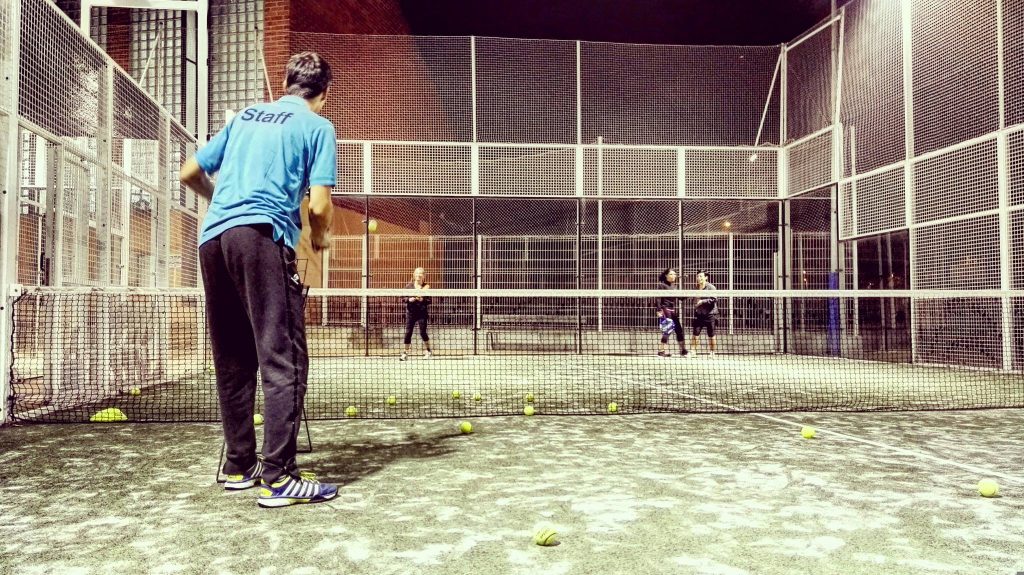











We told you in our previous article, our survey “Take lessons, what’s the point?” was wildly successful, with over 350 responses. After the numerical analysis, we give the floor to those of you who expressed the most relevant opinions on their expectations, what pushed them (or hindered them) to take lessons, what they lack and the level of satisfaction achieved.
► Your motivations
■ Yann, 45 years old, intermediate level, has been playing for 5 years: “The point that seduced me is the recurrence. I know that every Tuesday night there is padel, and regardless of the number of participants, it's training for padel ! Afterwards, the goal is to be able to get advice, rehearse and therefore improve in order to make the exchanges last in a match, and thereby have fun. Several levels of training are available at the club: competition and leisure. This makes the groups homogeneous because we are not all looking for the same goal”.
■ Bern, 40 years old, intermediate level, has been playing since 2018: “Taking lessons is to master the basics, deprogram tennis reflexes, make new gestures instinctive through repetition, work on and correct gestures and postures, tactics, work on the physical and cardio, regularity…”
■ Timothy, 39 years old, intermediate level, has been playing since 2016: "I needed advice to correct placement and gestures. Do repetition. Work on play areas on which we are less strong. And also to have tactical advice: which shot to play in which zone at which time…”
■ Julien, 30 years old, intermediate level, has been playing since 2019: “I felt that I was no longer progressing and, at the same time, I realized that my bases were fragile. I told myself that taking lessons would allow me to start a solid progression. »
■ Nathalie, 38 years old, expert level, has been playing for two years: "The idea was to play real padel, and not play – like the majority in France – tennis on a track of padel."
■ Lucille, 25 years old, expert level, has been playing for three years and takes two lessons a week (one individual, one collective): “I had the feeling of stagnating by just playing classic games with friends. I also wanted to learn more tactically. »
■ Timothy, 21 years old, intermediate level, has been playing for a year: “I wanted to learn the shots and tactics specific to padel, and also get rid of bad tennis habits. »
■ Vincent, 55 years old, intermediate level, has been playing for 4 years: “The lessons, I had been waiting for them from the start. I need routine to progress, to acquire automatisms with the windows. »
► What is holding you back
■ The price.- “It's too expensive” and “There are no courses in my sector” are the two arguments that come up the most in your remarks. Some even speak of “sport for the rich”… Lack of time is also a hindrance, especially when courses or courses are offered during the day. Many of you regret that there are no year-round courses and some prefer to watch tutorials online.
Simon, an expert level, doesn't take lessons because "it's too expensive, it's hard to find a competent teacher and, it's silly to say, but in tennis, I'm not used to paying and so it is difficult to take the leap”.
Bertrand, 27, has already completed an internship in Barcelona with OSS, but doesn't take lessons in France because “it's too expensive. I train independently with my partner, we do baskets or diagonals. Having an outside eye would be interesting but it's still too expensive… I prefer to go to Spain, but very occasionally. »
■ Teachers.- “In France, there are few high-performance teachers,” says Olivier, While Florent believes that "teachers are not teachers of padel but of tennis" and prefers a "real Spanish coach of padel ". In the eyes of Roman, “no instructor in France really has the level: it can be counted on the fingers of one hand and still…”.
As we have already mentioned, many of you have a hard tooth for some tennis teachers who, according to you, still have a lot to learn about tennis. padel (read below).
■ Insufficient supply, availability.- John 30 years old, deplores a lack of availability: “Currently in my club you have to book 3 or 4 months in advance to have it, it's far too long! »
“There are no courses in my area, sorry Max, 32 years old. It's too expensive, I would like to find a “club” operation with lessons on fixed days. Like in all sports.
► So, happy?
As we indicated in our first post, you are generally satisfied, even very satisfied with the courses or internships you have taken, with an average mark of 8/10. But let’s go into a little more detail with your assessments:
■ Nathalie, 47, gives a 7/10 to the group lessons she has had. According to her, "you should succeed in taking one or two individual lessons to work intensely on techniques not assimilated in group lessons".
■ Alexis, 51, has a satisfaction score of 7/10: “Taking group lessons is fun, we often see our mistakes much better, afterwards you shouldn't be too much either otherwise it breaks the dynamics of the course! »
■ Clement, 20, gives a 9/10 to his individual lessons: “They are really great, especially with passionate teachers and pedagogues! Being able to repeat the gesture several times and having an outside perspective is a real plus! »
■ Bernard, 42, gives an 8/10 but considers the lessons “too expensive… Too bad there isn't a club with two or three training sessions included in the fee, like badminton for example”.
■ Clementine, 27, finds one-on-one lessons "a bit frustrating because you can't see all the game patterns. Also, it can be discouraging because the game patterns can quickly put you in check when facing opponents your level, it's not the same". Despite this, she gives her classes a mark of 8/10.
■ Jérôme, 55, puts an overall score of 7/10 but differentiates the types of teaching: “The collective course is less expensive but the levels of the players are very different. For the basics, it's perfect. On the other hand, the private lesson is ideal for working on your own needs. Disadvantage, the prices remain off-putting in case of repeated needs (you have to add the rental of the land in addition to the course). Clubs should offer 5h or 10h all-inclusive packages or create courses for two players on a specific theme: bandeja, vibora, defense with one window, two windows, service, return, movement, tactical play…”
Jérôme recommends, "as in golf, that a teacher be present for 30 minutes or 1 hour during a game and return every two games to immediately improve the difficulties identified: placements, coordination of the pair, tactics, return of service... »
■ Slimane, 35, sees on the one hand the advantages: "being able to correct faults in the game on a daily basis with a more experienced person", but also the disadvantages: "the high cost prevents them from being able to take lessons regularly and therefore to assimilate notions learned more quickly”. His rating: 8/10.
■ Elodie, 37, is nuanced: “The introductory courses, I would say 8/10. The course, I would say 4/10 because the group was not at all of my level. Now we don't have a real teacher anymore. padel in the region, only tennis teachers who talk nonsense, so I don't take lessons anymore, unfortunately… But I plan to go to Spain for an internship. »
■ Opinion also nuanced for this 46-year-old intermediate player, who wished to remain anonymous, who gives his experience a 9/10: "The + is understanding the game, shots, placements, taking lessons in pairs, or individually to work and work on technical points where you are not progressing. The -, it's a bit of the price, of course, otherwise I would go every week, because it's really a source of phenomenal progress”.
■ valentine, 25, says it bluntly: “I don't like group lessons (4/10) and no teacher gives individual lessons at my place (Loir et Cher). The internship in Spain, on the other hand, was incredibly rewarding: I give it 9/10 because it's never perfect!! »
■ For this level 5-6 forty-something, “everything depends on the coach. For my first coach I would put 10, a coach of padel player of padel, in the top. My new coach is a tennis teacher and improvises as a tennis coach. padel because there is demand. It's good to offer group lessons, but the quality isn't really there. I just find a regular rhythm there, I will not continue next season. »
■ Bertrand, 27, gives a mark of 7/10: “In my opinion, being a physical education teacher is very interesting for beginners, because the margin for improvement is enormous. Then for the good players, everything can depend on the coach you come across. Personally, I was a little disappointed because we worked on a bit of everything (serve, return, volleys, double glass, smash, etc.) but without focusing on a specific point where we had the most to improve, such as the game with the windows. »
■ Yann, 45 years old “thinks that several factors make up the overall satisfaction of a course or training. First, there is the teacher, the feeling must pass with the student. And that's not debatable, it's a bit random. Likewise, getting along with the rest of the students is a big plus. To do this, you have to know what you are looking for in a course and share it when you register. A group where some want to compete while others just want to do a recreational sporting activity is hard to sustain in the long term. So, what I really liked was having a group where the level is quite similar and where everyone comes to have fun and have fun without getting too fussed and don't forget that there's a beer at the end! The friendly side of padel ! I would say an 8/10 rating. »
■ Xavier, 48 years old: “Satisfaction depends on the teachers. I had great pedagogues (top players or not) and that's the majority, but also top players who weren't too pedagogical (but super interesting and who challenge you) and teachers who knew less about the padel than me. There's a language barrier in Spain because I don't speak Spanish and their English isn't crazy [Editor's note: in Bilbao, Padel Stuff specializes in courses in French and English]. I find it difficult to put into practice what I learned, because in the basket, I play top 100 and in tournaments, even if I beat some once and hung other times, I am extremely far from this level. The strategy provided by the coach is not necessarily known to my partners and difficult to implement without looking like a “heavyweight”. Besides, it would be a good subject: how to send messages to your partner when he is technically or tactically mistaken? »
Conclusion: there's more than...
As we can read in your very interesting testimonials – for which we thank the authors – taking lessons is always, or almost always, a source of progress and satisfaction. If the price barrier is still very present and the offer is not always there, this step is essential to consider real progress and give the best of yourselves. The perfect lesson may not exist, but each student must find the right shoe or a palate on his arm: a bit like in life, isn't it?
A desire for internships? We offer you the must with the training directory and the directory of clubs padel.

After 40 years of tennis, Jérôme falls into the pot of padel in 2018. Since then, he thinks about it every morning while shaving… but never shaves pala in hand! Journalist in Alsace, he has no other ambition than to share his passion with you, whether you speak French, Italian, Spanish or English.





























































 P1000 Padel Arena: spectacle and surprises in Isneauville!
 France 2024 team training course – Discover the names of the players present
 A busy program for the French at FIP Rise in Burriana this Friday
 Ramón Morcillo: “I was surprised by France”
 Guillaume Codron: “South Padel, a family project”
 Nallé Grinda: “Democratize the padel in the USA with PadelX "
 Simon Boissé: “We know that there are two nations in front of us”
 The P500 tournaments at the P250 level of the time…
 How much does it cost to play with a pro or a coach in a tournament?
 TeamUp! Talents welcomes a new partner: Padel MagTV
 Betclic Remontada Padel : an initiation planned at the foot of the Eiffel Tower
 Pablo Cardona, a very big future?
 Pro Padel League: update on the ranking after the first two stages
 Where and when to see the very first match of the Belasteguin / Tello pair?
 Business plan padel : the 5 key points
 Ultra-luxurious residences with ski slopes padel floating in Dubai
 José Manuel Escin at the inauguration of Casa Padel DOS: “Finally, and thank you!”
 Padel Score comes to Tahiti for American Express Padel Cup!
 Brussels Premier Padel P2 – the final in stats
 Find out everything about the dimensions of a plot of land padel
 Presentation of the Wilson Bela V2.5 collection
 The LinkedIn of racquet sports: Racket Trip
 At the heart of padel – Episode 25: Paul and Andoni answer your questions
 At the heart of padel – Episode 23: defend the window well
 Prohibition on playing topless Padel : the reasons
 FIP Tour – Going far from Europe, THE strategy to earn points!
 What is a good football player? padel ?
 “Lefties give me headaches when I play against them!”
 At the heart of padel – Episode 14: how to earn points in winter?
 The basic tactics of padel
 A par 4 is always a winner...even if you manage to defend it!
 Carbon fiber VS fiberglass: what to choose?
 How to effectively test a racket padel ?
 La padel to fight Parkinson's disease
 Don't play with a cracked or broken racket, your body will thank you!
 Michel Cymes: “The padel, physically, it’s serious!”
 Our Top 10 training courses padel in France and Europe
 Jeremy Gala: “Promote the padel among young people in Belgium remains a challenge”
 The French Touch Academy organizes its selection day Padel-Study
 Report on the detection and training of younger generations